
Last December I sat down with my holiday gift list on the back of an envelope: fourteen names, from my two godchildren to the neighbor who feeds our cat when we travel. It added up to $640. I had been “saving whatever’s left at the end of the month” all year, and most months nothing was left. So the gifts went on three paychecks in a row, and January was spent catching up on December.

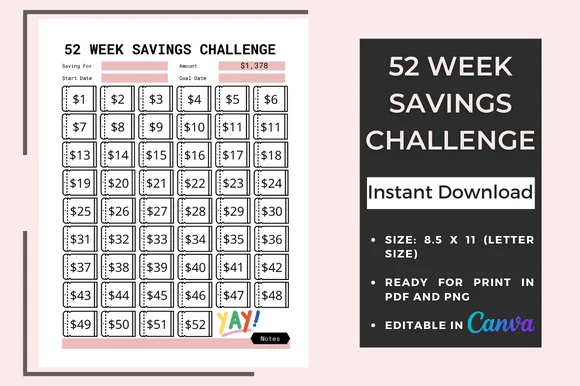
This year I wanted the money to exist before the list did. The 52 week savings challenge kept coming up: $1 in the first week, $2 in the second, up to $52 in the last, and $1,378 by December. I like that it starts small, but I didn’t want to do the math at the kitchen table every Friday. So I went looking for a 52 week savings challenge chart with the amounts already printed, and this is the one I found first. Every box from $1 to $52 is on the page, the top line already says “Amount $1,378”, and there’s a “Saving For” line where my gift list could go.
01 / Best overall
52 Week Savings Challenge Printable
Designed by BKS Studio.
 Best for the classic $1–$52 challenge
- PDF + PNG
- US Letter
- Canva editable
What’s insideOne 8.5 × 11 page with boxes from $1 to $52, “Saving For”, “Amount $1,378”, start and goal dates and a notes strip, in PDF and PNG plus a Canva template link.
- Boxes $1 to $52 printed
- “Amount $1,378” at the top
- Canva link inside the PDF
- 21 favorites on Creative Fabrica
Why I picked it
It’s the only chart in my list with every weekly amount already printed, so each week is one box to color and no math. The Canva link means the file can be recolored, or the amounts reordered for the reverse challenge, before printing.
Keep in mind: the preview’s second row shows “$11” twice where $12 should be, so check the PDF and fix that box in Canva if needed; it’s US Letter only and mostly black and white.
A chart with printed amounts solves the math, but my version of the problem has more sides. I’m paid every other Friday, so a weekly box doesn’t match my paycheck. December is the month I’m trying to protect, and in the standard order the four biggest deposits ($49 to $52) land right in it, which is why some people run the challenge in reverse. And I’d like the challenge on the same pages as my other goals for the year, not on a lone sheet. So I kept looking, and here are my other finds: a biweekly chart, two charts where you write your own amounts, and two planner-style options.
First comes the guide: how the challenge works, what the reverse, biweekly, flat and 53-week versions add up to, and a 5-step setup. Then the six charts, a comparison table, how to print them, and answers to common questions.
How the 52 Week Savings Challenge Works
The rule fits on one line: in week 1 you set aside $1, in week 2 $2, and each week you add a dollar until week 52, when you set aside $52. Added together, 1 + 2 + 3 + … + 52 comes to $1,378. That’s an average of $26.50 a week, though no single week looks like the average. Chase and PNC both describe the challenge this way, and both suggest moving each week’s amount into a savings account while you tick it off on paper.
The catch is the pace. The first quarter of the year asks for very little, and the last quarter asks for more than any other. Here is how the standard order and the reverse order spread the same total. I did the math myself.
Know the pace
The 52 week challenge, quarter by quarter
What each 13-week stretch asks of you.
| Quarter | Weeks | Standard ($1 up to $52) | Reverse ($52 down to $1) |
|---|---|---|---|
| Q1 | 1–13 | $91 | $598 |
| Q2 | 14–26 | $260 | $429 |
| Q3 | 27–39 | $429 | $260 |
| Q4 | 40–52 | $598 | $91 |
| Year | 1–52 | $1,378 | $1,378 |
The highlighted cell is the most expensive stretch of the standard challenge.
The order changes the pace; the total stays $1,378.
In the standard order the running total is $91 after 13 weeks, $351 at the halfway mark, $780 after 39 weeks and $1,378 at the end. The last four weeks alone add up to $202.
52 Week Savings Challenge Variations: Reverse, Biweekly, Flat and 53 Weeks
The same idea bends to different paydays and budgets. Here is what each common version asks for and what it adds up to.
Pick your version
52 week challenge variations and their totals
Same idea, different rhythm.
| Version | Deposits | Amounts | Total |
|---|---|---|---|
| Standard | 52 weekly | $1, $2 … $52 | $1,378 |
| Reverse | 52 weekly | $52, $51 … $1 | $1,378 |
| Biweekly, paired weeks | 26 paychecks | $3, $7, $11 … $103 | $1,378 |
| Biweekly, $2 steps | 26 paychecks | $2, $4 … $52 | $702 |
| Flat | 52 weekly | $26.50 every week | $1,378 |
| 53 weeks (2027 Fridays) | 53 weekly | $1, $2 … $53 | $1,431 |
| Half | 52 weekly | $0.50, $1 … $26 | $689 |
| Double | 52 weekly | $2, $4 … $104 | $2,756 |
The highlighted row only applies when your deposit day falls 53 times in the year.
Every total here is simple addition; check it against your own schedule.
- Reverse 52 week challenge. You start at $52 and count down to $1. The total is the same, but the big deposits come first: $202 after four weeks instead of $10, and only $10 across the last four weeks of the year. Savingadvice.com points out that this keeps the holidays light; the trade-off is a harder start in January.
- Biweekly savings challenge. If you’re paid every other week, you can pair the weeks. Paycheck 1 covers weeks 1 and 2 ($3), paycheck 2 covers weeks 3 and 4 ($7), and so on up to $103 on paycheck 26, still $1,378 in total. The 26-week chart in my list uses a gentler pattern instead: $2, $4 … $52, which adds up to $702.
- Flat amount. $26.50 every week also reaches $1,378. It’s the easiest version to set up as a recurring transfer, and the least fun to color in.
- 53 week money challenge. 2027 starts on a Friday and ends on a Friday, so it has 53 Fridays. If Friday is your deposit day, there’s a 53rd week. Carrying the pattern on to $53 makes the total $1,431. No bank names this as its own challenge; it’s just the 2027 calendar plus one more step.
$1,378 by December: Set Up Your 52 Week Challenge in 5 Steps
This is how I’d set up the challenge in one evening, using the charts below.

- Write down what the money is for. A line like “Saving for: holiday gifts” or “car repairs” makes the weekly box mean something. Every chart in this list has a goal line or a goal section.
- Pick the version that matches your paycheck. Paid weekly: the standard or reverse order on the 52 week chart. Paid every other week: the 26-week chart, or the paired amounts from the table above written into a blank chart.
- Check the hardest stretch against your budget. In the standard order that’s October to December ($598 in the last 13 weeks). If that’s when your bills pile up, write the amounts in reverse on the watercolor or eucalyptus chart. A budget planner printable shows where the weekly amount can come from. In my house it’s usually groceries, which is why dinners get planned on a weekly meal planner first.
- Choose a deposit day and mark it. Payday works for most people. Circle it on a printable 2027 calendar or write it into Friday’s box on a weekly planner printable so the deposit has a set time. If you run your week from a to-do list printable, add the transfer as a line of its own.
- Move the money, then color the box. Banks such as Chase suggest transferring each week’s amount to a savings account; the chart is the record you can see. If you miss a week, pick up where you left off and catch up only when your budget allows.
The 6 Best 52 Week Savings Challenge Charts I Found
I left out interiors made for publishing on Amazon, digital-only planners, design source files and bundles sold for commercial use. I also skipped anything already reviewed in my savings challenge printables roundup, which covers the 100 envelope, no-spend and color-in goal trackers. Every pick here is a 52-week or biweekly chart you print at home, and no designer appears more than twice. Charts with printed amounts come first, then charts where you write your own, then planner pages.
TL;DR: six printable 52 week savings challenge charts in three groups. Printed amounts: a $1–$52 chart with “Amount $1,378” and a 26-week biweekly chart that totals $702. Write your own: a turquoise watercolor chart with a running total and a eucalyptus “One year Saving Challenge”. Planner pages: a two-page pastel savings challenge set and a 35-page 2027 savings goal record. The cards list sizes and what each one includes.

Find your favorite
Quick Picks
Choose a 52 week savings chart to jump to its review.
- 01Best overall52 Week Savings Challenge Printable
- 02Best for biweekly pay26 Week Savings Challenge Printable
- 03Best for your own amountsSaving Challenge Tracker Printable PDF
- 04Best botanical chart52 Week Savings Challenge, Money Savings
- 05Best pastel two-page setPastel Savings Challenge Printable
- 06Best whole-year planner2027 Savings Goal Record | Printable
How I chose. In order of weight: it’s a 52-week or biweekly savings chart you print at home; it fits one of the versions above, either with the amounts printed or with blank lines for your own; it comes in US Letter or A4; there’s room for the goal, dates and a running total; and the design is one you’d leave on the fridge. Everything below comes from each product’s page on Creative Fabrica, checked on October 25, 2026, including the favorites counts shown there. I haven’t printed these charts myself, so I describe what the designer lists and shows, and I say where a detail isn’t stated.
02 / Best for biweekly pay
26 Week Savings Challenge Printable
Designed by BKS Studio.
 Best for every-other-week paychecks
- PDF + PNG
- US Letter
- Canva editable
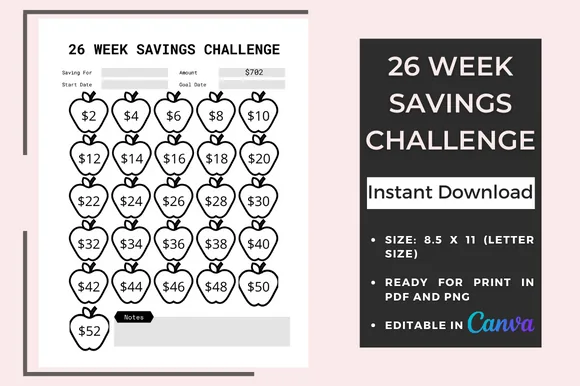
What’s insideOne 8.5 × 11 page with 26 apples from $2 to $52, “Amount $702”, “Saving For”, start and goal dates and notes, plus a Canva template link.
- 26 apples, $2 to $52
- “Amount $702” printed
- Canva link inside the PDF
- 12 favorites on Creative Fabrica
Why I picked it
Twenty-six boxes match twenty-six paychecks, so a biweekly payday gets one apple each time. The $2 steps keep the biggest deposit at $52, half of the $103 the paired-weeks version needs.
Keep in mind: the $2 steps add up to $702, not $1,378; it’s US Letter only, and the apples are black and white unless you recolor them in Canva.
03 / Best for your own amounts
Saving Challenge Tracker Printable PDF
Designed by Smokecloud.
 Best for reverse or custom amounts
- PDF + PNG
- A4 + A5
- Portrait
What’s insideA ZIP with A4 and A5 versions (2 PDF, 2 PNG) of a chart with “Saving For”, weeks 1–52, “Amount Saved” and “Running Total” columns and a “Saving Total” line.
- Weeks 1 to 52 listed
- Amount Saved and Running Total
- Turquoise watercolor with gold
- 15 favorites on Creative Fabrica
Why I picked it
The amount column is blank, so it works for the reverse order, the flat $26.50 or the paired biweekly amounts. The running total column is the part I’d want most, because the year adds up on the page as you go.
Keep in mind: there’s no US Letter version, so on Letter paper you’d print with “Fit” and get wider margins.
04 / Best botanical chart
52 Week Savings Challenge, Money Savings
Designed by Dan Ste.
 Best for a sage green fridge chart
- A4
- Portrait
What’s insideOne A4 PDF titled “One year Saving Challenge” with weeks 1–52 in two columns, each with a “Deposit” and a “Balance” box, framed in watercolor eucalyptus.
- Weeks 1 to 52, two columns
- Deposit and Balance boxes
- Watercolor eucalyptus border
- 32 favorites on Creative Fabrica
Why I picked it
It has the most favorites of the six and the sage and eucalyptus look I’d happily leave on the fridge all year. Blank deposit boxes fit any version of the challenge, and the balance column keeps the running total.
Keep in mind: it’s A4 only, and one gallery image says “72 weeks / A4 Sheet” while the cover shows 52, so check the page after download.
05 / Best pastel two-page set
Pastel Savings Challenge Printable
Designed by Mol Tazime.
 Best for 52 weeks plus a no-spend month
- US Letter + A4
- 2 pages
What’s insideTwo undated pages in A4 and US Letter PDFs: a savings challenge tracker with 30-day and 52-week challenges, and a goals planner with an emergency fund tracker and a 31-day no-spend challenge.
- Savings goal and target amount
- 30-day and 52-week challenges
- 31-day no-spend challenge
- Blush, sage, peach and lavender
Why I picked it
It’s the brightest option here, with pastel colors and florals on both pages and both paper sizes in the download. The designer notes the amounts aren’t predetermined, so any version of the challenge fits, and page 2 adds an emergency fund tracker and a no-spend month.
Keep in mind: the 52-week challenge shares page 1 with other trackers, so its boxes are smaller than on a full-page chart.
06 / Best whole-year planner
2027 Savings Goal Record | Printable
Designed by Designs Market.
 Best for planning all of 2027
- Size not stated
- 35 pages
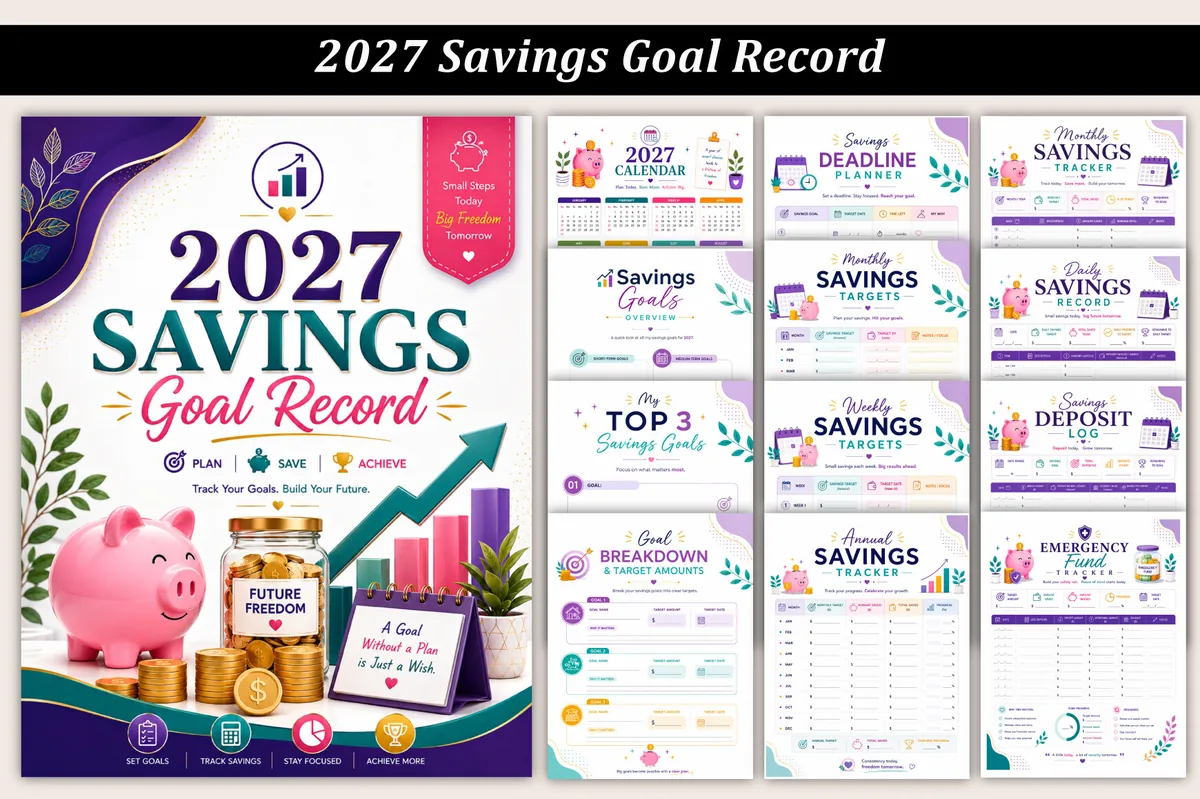
What’s insideA 35-page 2027 savings workbook: savings vision, a 2027 calendar, top 3 goals, weekly and monthly targets, deposit logs, fund trackers, a no-spend tracker and a 52-week savings challenge.
- 2027 calendar and savings vision
- Weekly savings log
- Emergency and vacation funds
- 52-Week Savings Challenge page
Why I picked it
If the challenge is one of several money goals for 2027, this keeps them together: goals, deadlines, weekly targets and a deposit log sit next to the 52-week page. The purple and pink pages suit a binder more than a fridge.
Keep in mind: the page size isn’t stated, the pages are dated for 2027, and it shows only 2 favorites so far.
Quick Comparison
| Printable | Style | What’s inside | Sizes / format | Standout |
|---|---|---|---|---|
| 1. 52 Week Printable | Pink and black | 1 page, $1–$52 boxes | Letter / PDF, PNG, Canva | “Amount $1,378” printed |
| 2. 26 Week Printable | Black-and-white apples | 1 page, $2–$52 | Letter / PDF, PNG, Canva | Fits a biweekly payday |
| 3. Watercolor Tracker | Turquoise and gold | Weeks 1–52, running total | A4, A5 / PDF, PNG | Write any amounts |
| 4. Eucalyptus Chart | Sage eucalyptus | Weeks 1–52, deposit and balance | A4 / PDF | 32 favorites |
| 5. Pastel Challenge | Pastel florals | 2 pages | Letter, A4 / PDF | 52-week plus no-spend |
| 6. 2027 Goal Record | Purple and pink | 35 pages | Not stated / PDF | Whole year of goals |
Printed Amounts, Blank Lines or a Planner: Which 52 Week Chart Fits You
The six charts do three different jobs. The right one depends on which version of the challenge you’re running.
Charts with the amounts printed
For the classic challenge with no math: the 52 week chart with $1 to $52 in boxes, and the 26-week chart for a biweekly paycheck. Both come with a Canva link if you want to change the order.
Charts where you write your own amounts
For the reverse, flat, half, double or 53-week versions: the turquoise watercolor tracker with a running total column, and the eucalyptus chart with deposit and balance columns.
Planner pages with a 52-week section
For keeping the challenge next to other goals: the two-page pastel set adds a no-spend month and an emergency fund tracker, and the 2027 goal record covers the whole year in 35 pages.
What I Look For in a 52 Week Savings Chart
- The right number of boxes. 52 for weekly deposits, 26 for biweekly. A blank chart covers everything else, including a 53rd week written on the margin.
- Printed or blank amounts. Printed amounts save time each week; blank lines let you run the challenge in reverse or scale it down.
- A running total. A “Running Total” or “Balance” column shows the year adding up without a calculator.
- Your paper size. US Letter in the US, A4 almost everywhere else. Only the pastel set includes both; the two BKS charts are Letter only, and the watercolor and eucalyptus charts are A4 (plus A5 for the watercolor one).
- A goal line. “Saving For” or “Savings Goal” at the top turns a grid into a plan.
- Red flags in a listing. “KDP interior”, “ready to upload”, “6 × 9 trim” or “for commercial use” usually means the file was made for resale, not for a chart on your fridge.
If you like seeing a whole year of small steps on one page, the same idea runs through habit tracker printables: one box a day or a week, colored when it’s done.
If saving a set amount each week feels slow, the 100 envelope challenge mixes up the amounts and can finish in 100 days.
How to Print and Use a 52 Week Savings Challenge Chart
- Paper. A chart that lives on the fridge for a year holds up better on 65–80 lb cover cardstock than on copy paper. Check your printer’s maximum paper weight first.
- Size and scale. US Letter is 8.5 × 11 in; A4 is 210 × 297 mm, a little narrower and taller. Print at 100% or “Actual size”. Use “Fit” only when you print an A4 file on Letter paper or the other way around.
- Canva files. The two BKS Studio charts include a Canva template link in the PDF. You can change the colors, fix a typo or swap the order of the amounts before printing.
- Laminate for dry-erase. A 3–5 mil laminating pouch lets you reuse a blank chart next year with a dry-erase marker. Leave the printed-amount charts unlaminated if you want to color them in with pencil.
- Keep it where you’ll see it. The fridge, the inside of a cabinet door, or a binder next to your monthly calendar printables.
A little help
Paid every other Friday? The biweekly savings challenge uses 26 boxes instead of 52, one for each paycheck.
Want to save toward your own goal instead of the 52-week amounts? These savings goal trackers work for any amount and date.
Frequently asked questions
A few answers before you print.
How much do you save with the 52 week savings challenge?
You save $1,378 in a year. You set aside $1 in week 1, $2 in week 2, and so on up to $52 in week 52. That averages $26.50 a week, but the deposits grow over time: the first 13 weeks add up to $91 and the last 13 weeks to $598. Running it in reverse gives the same total with the big weeks first.
The 52 week math: $1 to $52, one a week $1,378 in total $26.50 a week on average
Can you do the 52 week challenge biweekly?
Yes. Pair the weeks so each paycheck covers two of them: $3, then $7, then $11, up to $103 on the 26th paycheck, which still adds up to $1,378. A gentler biweekly version uses $2 steps from $2 to $52 and adds up to $702. That’s the pattern printed on the 26-week chart in this list.
What is the reverse 52 week savings challenge?
It’s the same challenge in the opposite order. You set aside $52 in week 1 and count down to $1 in week 52. The total is still $1,378, but the last four weeks of the year need only $10 instead of $202. Many people use it to keep December light. The trade-off is a bigger start in January.
Is there a 53 week money challenge?
Some years have a 53rd deposit day. 2027 starts and ends on a Friday, so it has 53 Fridays. If you save on Fridays and continue the pattern to $53 in the last week, the total becomes $1,431. Most charts stop at week 52, so a blank chart or the margin works for the extra week.
What happens if I miss a week of the 52 week challenge?
Nothing is lost except that week’s box. Pick up where you left off and fill in the missed amount later, when your budget allows. A chart with blank amount lines makes it easy to note a catch-up. You can also start the challenge in any week of the year; it doesn’t have to be January.
What paper is best for a 52 week savings chart?
Use 65–80 lb cover cardstock if the chart will hang on the fridge for a year, and print at 100% or “Actual size” on US Letter or A4, whichever the file is made for. If you want to reuse a blank chart, laminate it in a 3–5 mil pouch and fill it in with a dry-erase marker.
Want to go bigger than the classic 52 weeks? A 10000 savings challenge is about $192.31 a week.
Final Thoughts
If you want the classic challenge with no math, the 52 week chart with printed amounts is the simplest start. Pair it with the two-page pastel set if you also want a no-spend month and an emergency fund page. If December is the month you’re protecting, take the turquoise watercolor tracker and write the amounts in reverse, from $52 down to $1. Either way, put your goal on the top line and choose your deposit day before week 1 begins. If the money is for something specific, like a trip, pin a picture of it on a vision board for 2027 next to the chart.
Saving for a trip? Write it on a travel bucket list printable so the money has a destination.