For about two weeks last spring, every evening in our house ended the same way: my four-year-old nephew, who was staying with us, refused to put his shoes by the door, I asked five times, and we both went to bed cross. I didn’t need a lecture on parenting. I needed a way to notice the evenings he did it right. A behavior chart printable is the simplest version of that: one clear goal, a row of empty spaces, and a sticker each time it happens. The one I found first is built around exactly that idea, with 10-, 20- and 30-step charts, a reward menu and a page for grown-ups on making it work.

01 / Best overall
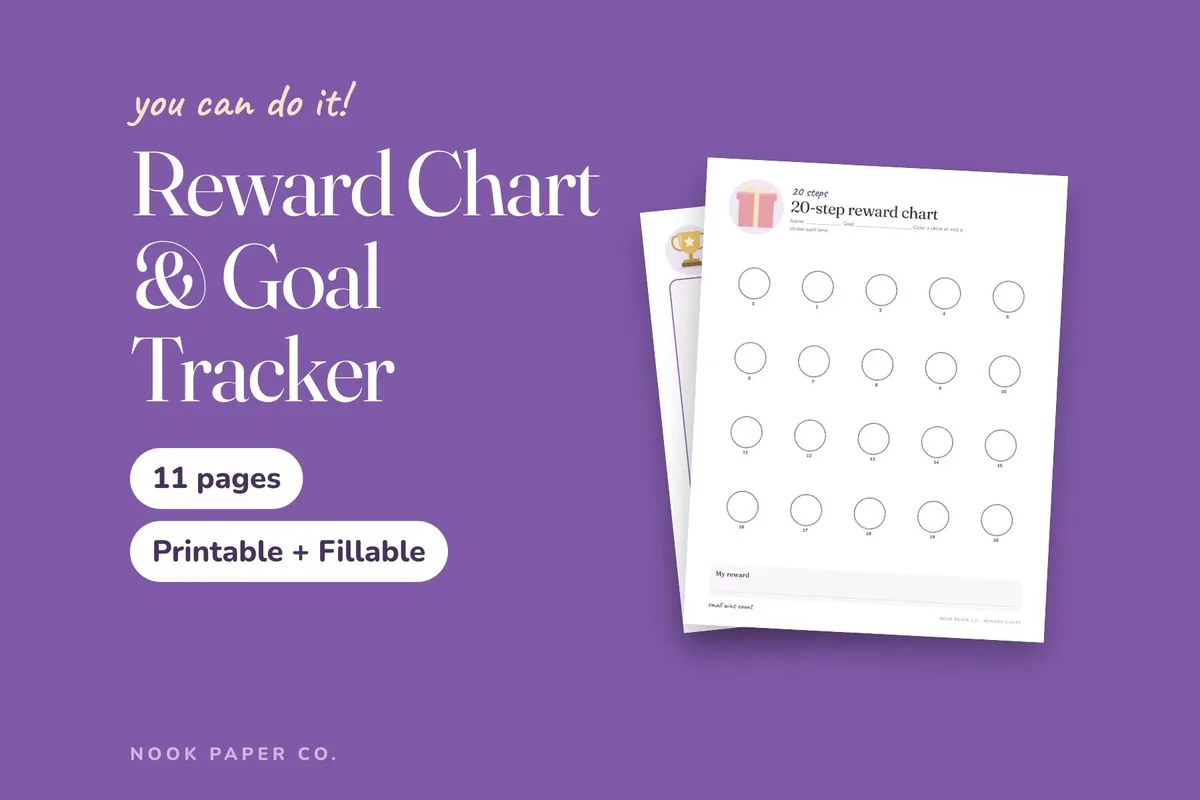
Behavior Reward Chart & Goal Tracker
Designed by Nook Paper Co.
 Best for one goal at a time
- PDF + fillable PDF
- US Letter + A4
- 11 pages
What’s insideAn 11-page undated purple set: a page on making a reward chart work for grown-ups, a my goal page, 10-, 20- and 30-step reward charts, a weekly behavior chart, a small, medium and big reward menu, a goal reached certificate and notes, as a printable PDF in US Letter and A4 plus a fillable PDF.
- 10, 20, 30-step charts
- Reward menu
- Grown-up guide page
- Fillable PDF
Why I picked it
It’s built around one goal at a time, the way the CDC and child therapists suggest, and the 10-step chart lets you start small.
Keep in mind: it’s a new listing, so there are no favorites yet.
Behavior has a few more sides than shoes, though. Some kids respond to a big sticker sheet, some need help with feelings before rules, and some families are in the middle of potty training. So I kept looking, and here are my other finds. Before them: how to set up a chart so it actually helps, and rewards that don’t cost much.
Why a Behavior Chart Helps
A chart turns attention toward the good moments. The CDC’s parenting guidance says behaviors are more likely to happen again when a positive consequence, like a reward, follows them, and that for young children a chart with pictures is a common way to keep track (CDC).
It also changes the tone of the day. The CDC points out that toddlers and preschoolers hear “no,” “stop” and “quit” many times a day, and that earning a reward lets a child know they did something you like. A sticker on the fridge is a small, visible yes.
A behavior chart works alongside your routines rather than replacing them. If mornings are the struggle, my kids routine chart printables show each step, and the behavior chart rewards the one step you’re working on.
How to Set Up a Behavior Chart That Works
The CDC lays out six steps, and a behavior chart handout from the University of Oklahoma’s Child Trauma Services Program says much the same (OUHSC handout). Here’s how I’d put them together:

- Start with one behavior. The OUHSC handout says to begin with a single behavior and goal; the CDC says a couple at most.
- Say what you want, not what you don’t. “Share your toys with your sister,” not “No hitting your sister.” “Be good this week” is too vague for a child, the handout notes.
- Make the first goal easy. For a child who hits almost every day, the handout’s first-week goal is 1 or 2 days without hitting. Early success teaches how the chart works.
- Use pictures. The CDC suggests simple words plus a picture, like a toothbrush next to “Brush teeth,” and a spot the child sees every day, such as the fridge.
- Explain it and reward right away. Show the chart and the sticker, then give the sticker straight after the behavior, with specific praise: “You put your plate in the sink!”
- Never take a sticker back. The CDC is firm on this: rewards a child has earned are theirs. On a day without one, the handout suggests refocusing on the next sticker instead.
Once the behavior becomes a habit, reward it less often and move to a new goal, or retire the chart. If it isn’t working, the CDC suggests checking three things: can your child actually do it, is the behavior clear enough, and does your child care about the reward. This approach is for everyday behavior; if you’re worried about aggression, development or ADHD, talk to your pediatrician first.
Rewards That Don’t Cost Much
The CDC says social rewards (hugs, high fives, specific praise and extra time with you) can be even more powerful than toys. The OUHSC handout lists low-cost ideas and suggests letting the child help choose them:
- Choosing what’s for dinner.
- A book or a game with a parent.
- Staying up 20 minutes later.
- Helping cook dinner.
- A little extra screen time.
- A “grab bag” of small rewards, swapped often so they stay exciting.
The handout also suggests stickers daily and the bigger reward weekly. A reward menu with small, medium and big rewards, like the one in pick 1, makes that easy to plan. For more ideas on charts that build to a prize, see my reward charts for kids.
The 9 Best Behavior Chart Printables I Found
I left out a behavior log sold for print-on-demand and KDP books, a 6 x 9 visual cards set, clipart reward jars, and the charts I already covered in my reward and routine chart lists, so this one doesn’t repeat them. What’s left is nine printables you can use at home, with no more than two from one designer: behavior and sticker charts first, then kindness and responsibility, then three potty charts.
In short: print the Nook Paper Co. chart to work on one goal, the Creative and Elegant Studio set for sticker charts of every length, the Mol Tazime pages for kindness and manners, and the Haffa Studio or Nook potty chart if that’s the stage you’re in.
Find your favorite
Quick Picks
Choose a chart to jump to its review.
- 01Best overallBehavior Reward Chart & Goal Tracker
- 02Best sticker chartsKids Reward Charts and Stickers
- 03Best with emotionsKids Daily Checklist
- 04Best for kindnessKids Kindness & Good Manners Printable B
- 05Best points systemKids Responsibility Tracker Printable
- 06Best three-in-oneKids Routine Bundle Printable
- 07Best potty setPotty Training Chart & Log
- 08Most-loved potty chartPrintable Kids Potty Training Chart
- 09Best editable potty chartPotty Training Chart Editable Template
How I chose. In order of weight: a behavior, sticker or potty chart made to print at home rather than for resale; space for a clear goal and reward; a stated size or format; and a mix of behavior, sticker, kindness, chore and potty charts. Everything below comes from each product’s page on Creative Fabrica, checked on November 20, 2026, including the favorites counts shown there. I haven’t printed these myself, so I describe what each designer lists and shows.
02 / Best sticker charts
Kids Reward Charts and Stickers
Designed by CREATIVE & ELEGANT STUDIO.
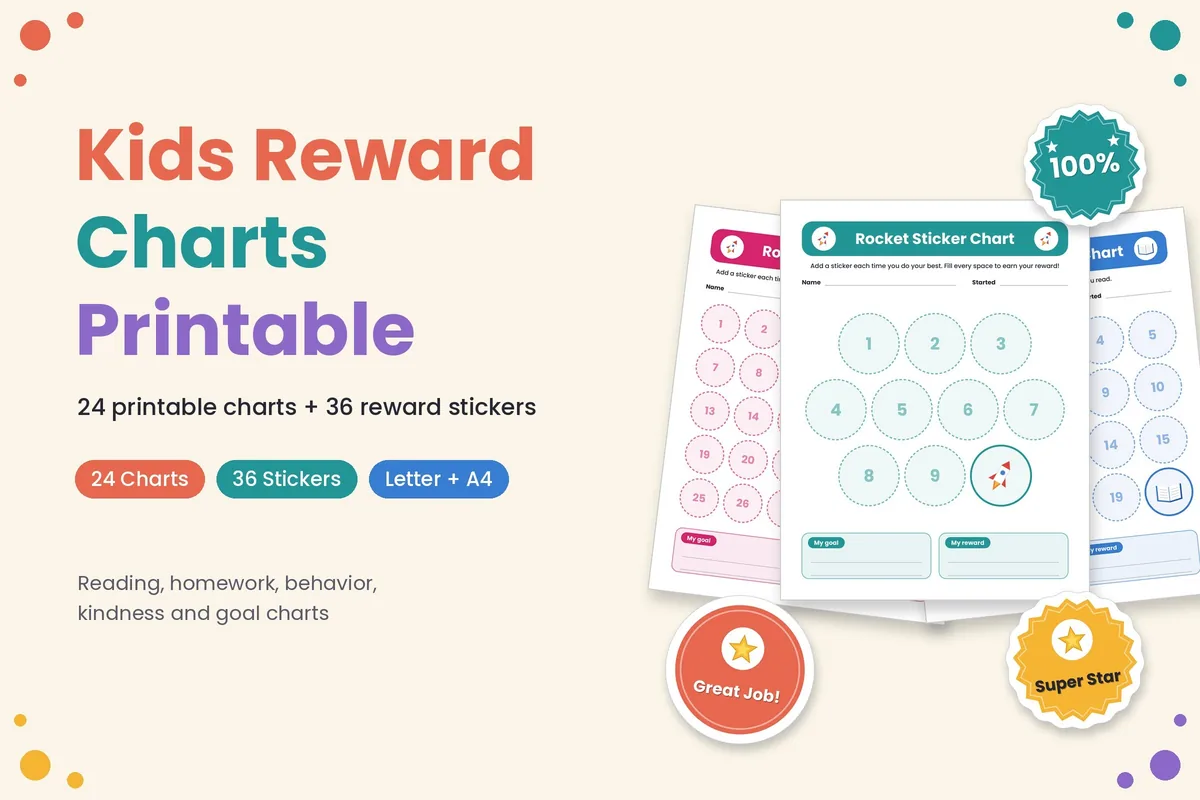 Best for sticker charts of every length
- PNG + PDF
- Letter + A4
- 24 charts + 36 stickers
What’s inside24 undated charts (six themes with 10, 20 and 30 spaces, plus reading, homework, good behavior, kindness, goal and weekly behavior charts) and 36 printable reward stickers on sheets in Letter and A4, with name, goal and reward boxes on every chart.
- 24 charts
- 36 stickers
- Weekly behavior chart
- 10 to 30 spaces
Why I picked it
Charts with 10, 20 or 30 spaces let you match the length to your child’s age, and the stickers are sized to fit.
Keep in mind: there are no favorites yet, and the bright themes are busy for an older child.
03 / Best with emotions
Kids Daily Checklist
Designed by BookWorm Haven.
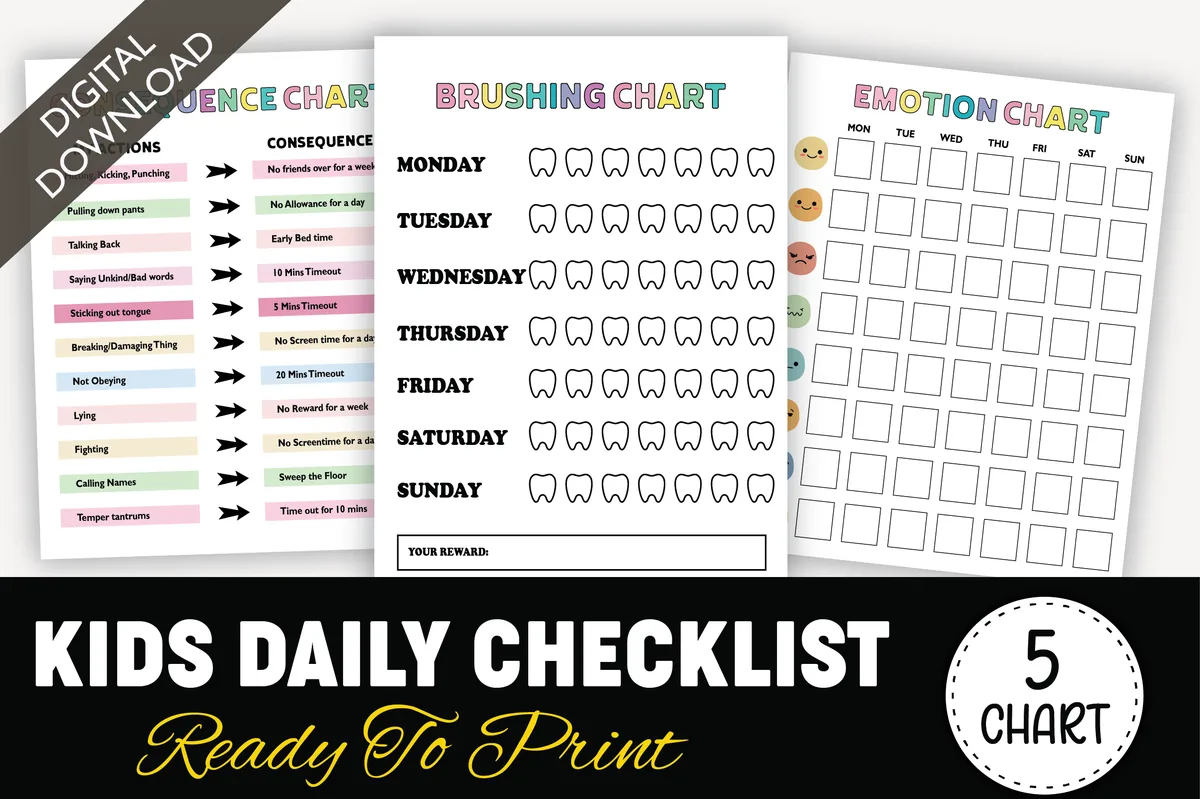 Best for behavior, habits and feelings
- Printable
- 5 charts
- Weekly + monthly
What’s insideFive charts: a behavior chart, a brushing chart, a consequence chart, an emotion chart and monthly habit trackers for reading, healthy eating, sleeping on time, putting away toys and exercising.
- Behavior chart
- Emotion chart
- Habit trackers
- 52 favorites
Why I picked it
The emotion chart sits next to the behavior chart, which helps when a hard moment is about big feelings rather than rules.
Keep in mind: it includes a consequence chart, which you can leave out if you’d rather focus on rewards.
04 / Best for kindness
Kids Kindness & Good Manners Printable B
Designed by Mol Tazime.
 Best for manners and sharing
- A4 + US Letter
- 10 pages
What’s insideA 10-page pastel set: a kindness checklist, say please and thank you, use kind words, take turns, share with others, help someone today, good manners at home and at school, a kindness reward chart and a weekly kindness tracker, in A4 and US Letter.
- Kindness reward chart
- Weekly tracker
- Manners at school
- A4 and Letter
Why I picked it
Every page names one positive behavior, like taking turns, which is exactly how the CDC suggests wording a chart.
Keep in mind: it has 5 favorites so far, and the pages are about manners only.
05 / Best points system
Kids Responsibility Tracker Printable
Designed by Jennifer Magri Designs.
 Best for older kids and points
- 5 sizes
- 5 colors
What’s insideFive responsibility trackers in rainbow, pink, blue, yellow and a printer-friendly gray, with daily and weekly chores, total points, a goal and a reward, in A4, A5, US Letter, Half Letter and HP Classic.
- Points and reward
- Printer-friendly gray
- Five sizes
- 120 favorites
Why I picked it
Points suit school-age kids who want to save up for something bigger, and it has the most favorites of any pick.
Keep in mind: it tracks chores and responsibilities more than behavior.
06 / Best three-in-one
Kids Routine Bundle Printable
Designed by AtelierPlanCo.
 Best for behavior, chores and rewards
- PDF + PNG
- A4, A5, US Letter
- 3 charts
What’s insideThree charts (a behavior chart, a chore chart and a reward chart) as A4, A5 and US Letter PDFs, a digital PDF for tablets and A4 PNGs.
- Behavior chart
- Chore chart
- Reward chart
- Three sizes
Why I picked it
If you want behavior, chores and the reward on matching pages, this small set covers all three.
Keep in mind: it has 1 favorite so far, and the soft pastels are faint on the cover.
07 / Best potty set
Potty Training Chart & Log
Designed by Nook Paper Co.
 Best for the whole potty training stage
- PDF + fillable PDF
- US Letter + A4
- 10 pages
What’s insideA 10-page undated blue potty training set: tips and supplies for grown-ups, a potty sticker chart with 30 spaces, 2 daily potty logs, progress steps, a weekly tracker, a potty star certificate and notes, in US Letter and A4 plus a fillable PDF.
- 30-sticker potty chart
- Daily potty log
- Certificate
- Fillable PDF
Why I picked it
It pairs the sticker chart with a log, so you can see the times of day that work, and it says plainly that the tips aren’t medical advice.
Keep in mind: it’s a new listing with no favorites yet.
08 / Most-loved potty chart
Printable Kids Potty Training Chart
Designed by Haffa Studio.
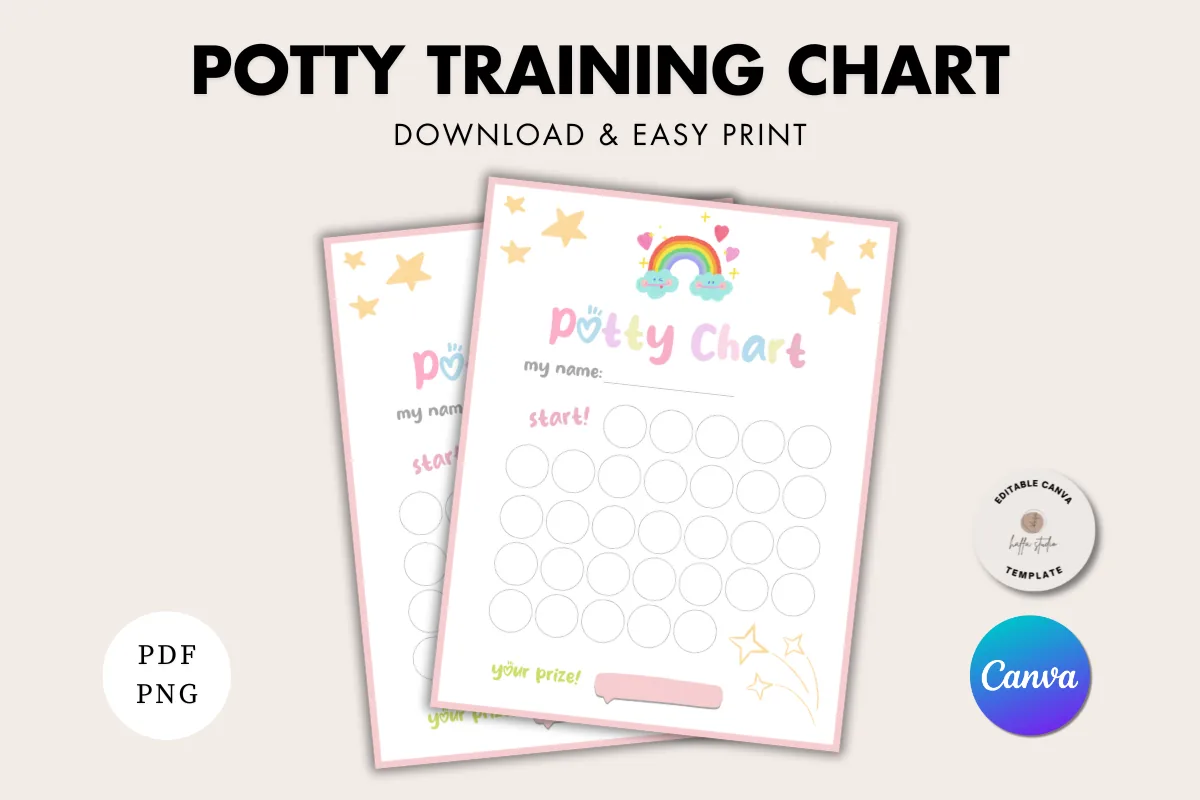 Best for a single cheerful page
- PDF + PNG
- 1 page
- Rainbow design
What’s insideA single rainbow potty chart with circles for stickers or magnets, a name line and a prize at the end, as a ready-to-print PDF and PNG.
- Circles for stickers
- Prize at the end
- PDF and PNG
- 78 favorites
Why I picked it
One cheerful page is often all a toddler needs, and it’s the most-favorited potty chart I found.
Keep in mind: the listing doesn’t state a paper size.
09 / Best editable potty chart
Potty Training Chart Editable Template
Designed by hanacrochetdesign.
 Best for adding your child’s name
- PDF, EPS, SVG
- Editable
- Sticker cut file
What’s insideAn editable potty training chart (change the name and colors in Canva or the PDF), an EPS and Illustrator vector file, and an SVG sticker file for Cricut and other cutting machines.
- Editable name
- Watercolor design
- SVG reward stickers
- 6 files
Why I picked it
Your child’s name on the chart makes it feel like theirs, and the matching sticker file means the rewards match the page.
Keep in mind: the sticker file needs a cutting machine, and there’s no size listed for the chart.
Quick Comparison
| Product | Type | What’s inside | Sizes/format | Standout |
|---|---|---|---|---|
| 1. Behavior Reward Chart & Goal Tracker | Behavior | 11 pages | Letter, A4, fillable | Reward menu |
| 2. Kids Reward Charts and Stickers | Sticker charts | 24 charts, 36 stickers | Letter, A4 | 10 to 30 spaces |
| 3. Kids Daily Checklist | Behavior + feelings | 5 charts | Not stated | Emotion chart |
| 4. Kindness & Good Manners | Kindness | 10 pages | A4, Letter | Take turns, share |
| 5. Kids Responsibility Tracker | Points | 5 trackers | 5 sizes | 120 favorites |
| 6. Kids Routine Bundle | Behavior + chores | 3 charts | A4, A5, Letter | Reward chart |
| 7. Potty Training Chart & Log | Potty | 10 pages | Letter, A4, fillable | Daily log |
| 8. Kids Potty Training Chart | Potty | 1 chart | PDF, PNG | 78 favorites |
| 9. Editable Potty Chart | Potty | 6 files | PDF, EPS, SVG | Child’s name |
Behavior, Sticker or Potty Chart
A behavior chart for one goal
Picks 1, 3 and 6 name the behavior and track it through the week. They suit toddlers through early school age working on one or two habits. If your child is older and wants to save up for something, the points in pick 5 or a chore chart printable with a weekly total will hold their interest longer.
Sticker charts and kindness pages
Picks 2 and 4 are the classic sticker charts: fill the spaces, earn the reward. They’re good for preschoolers who love stickers. For more sticker sheets, my list of printable planner stickers has small sets that fit a chart. If your child loses interest in stickers quickly, switch to social rewards rather than buying more.
Potty training charts
Picks 7 to 9 are made for potty training, with a sticker for each success and, in pick 7, a log of times. They’re for the potty stage only. If you’re still tracking feeds and naps, my baby tracker printables come first, and your pediatrician can tell you when your child is ready.
How to Print and Use Your Chart
Check the size first: picks 1, 2, 4 and 7 come in US Letter and A4, pick 5 in five sizes, and picks 3, 8 and 9 don’t list a paper size. If you print an A4 file on Letter paper, choose Fit to page.
Put the chart at your child’s eye level, on the fridge or their bedroom door. For a chart you reuse every week, slip it into a sheet protector and use reusable stickers or a dry-erase marker for the spaces. Card stock holds up better on a door than plain paper.
For pick 2, the designer gives sizing tips: print the sticker sheets at 80% for the big 10-space charts and at 60% for the 20- and 30-space charts. For the tidy-room kind of goal, my clean room checklist printables pair well with a sticker chart.
A little help
Frequently asked questions
A few answers before you print.
How do you use a behavior chart?
Pick one specific behavior, write it in positive words, and show your child the chart and the sticker. Give the sticker right after the behavior with specific praise, and give the bigger reward at the end of the week. Never take an earned sticker back.
Good to know: One behavior to start Reward right away Never take stickers back
What age is a behavior chart for?
The CDC’s guidance on reward charts is written for toddlers and preschoolers, and it says to pick behaviors that fit your child’s age. Pictures help young children; older kids often prefer points or a weekly total.
What should I put on a behavior chart?
One or two clear behaviors, a space for each day or each success, and the reward your child is working toward. A picture next to each behavior helps children who can’t read yet.
How many squares should a sticker chart have?
Start small so your child reaches the reward quickly, like a 10-space chart, then move to 20 or 30 spaces once the routine is clear. The OUHSC handout’s example uses 7 stickers for one reward.
Do behavior charts work for kids with ADHD?
Reward charts are a common part of behavior plans, but every child is different. If your child has ADHD or you’re concerned about their behavior, ask your pediatrician or a child therapist how to set up a chart for them.
How do I make a potty training chart?
Use a page with a row of circles or squares, add your child’s name, and give a sticker for each success. A small prize at the end of the row keeps it exciting. Ask your pediatrician if you’re unsure whether your child is ready.
Final Thoughts
A behavior chart works when it’s simple: one goal, positive words, a sticker right away and a reward your child actually wants. Start easy, praise specifically, and never take a sticker back. If you print one, the Nook Paper Co. chart is the best place to start, and the Mol Tazime kindness pages are a gentle next goal. For potty training, the Haffa Studio chart is one cheerful page.