Two springs ago my flight home from Lisbon was cancelled, and the rebooking, a hotel night and two airport dinners came to just under a thousand dollars. I paid it on a credit card and spent the summer paying it off. When I got home, I printed a chart of little circles, taped it inside my closet door and started the $1,000 savings challenge: color in a circle every time money goes into savings, until all of them are filled.
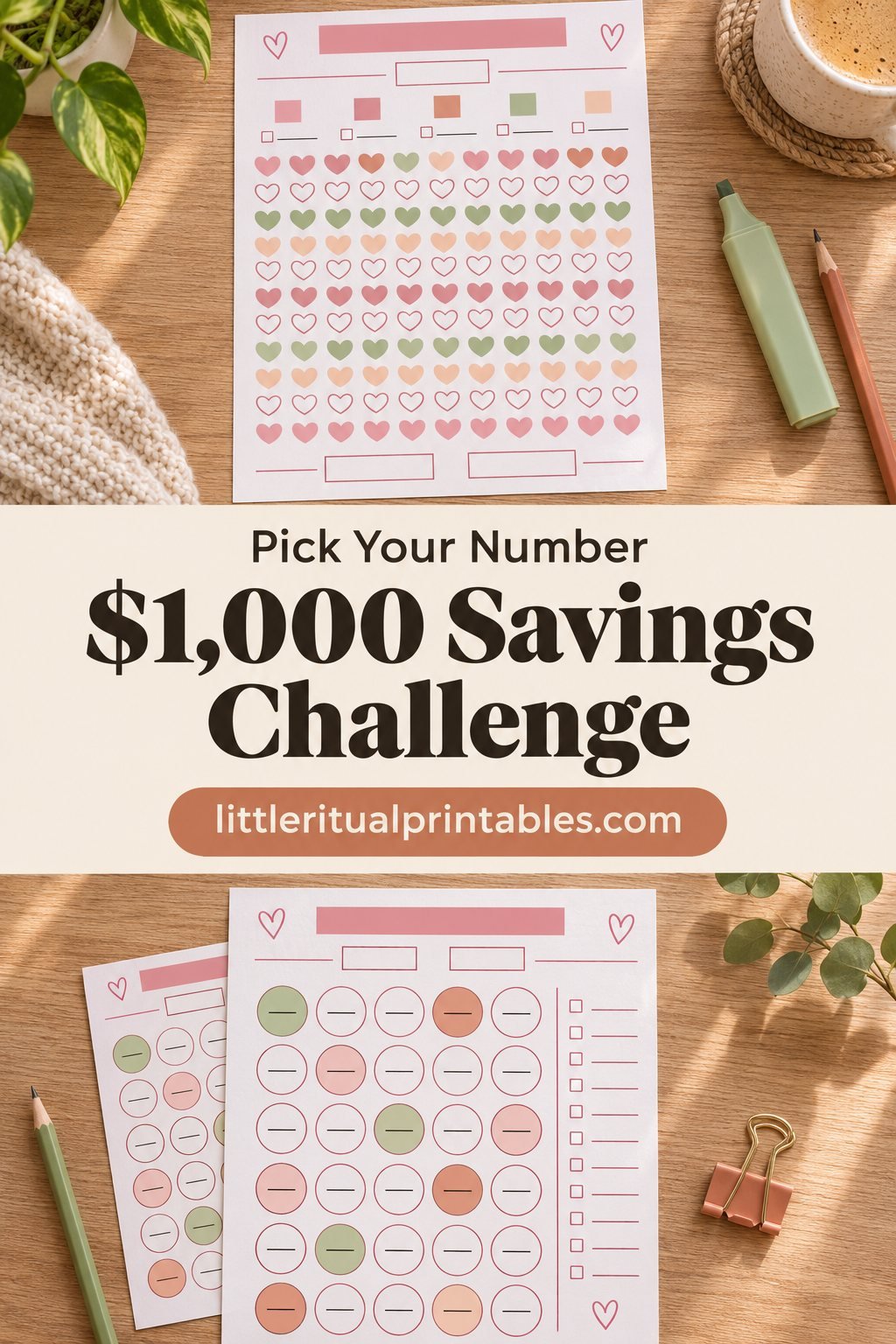
It took me six months. Below is how the challenge works, the exact amounts for $1,000, $2,000 and $5,000 over three, six or twelve months, where to keep the money and how to start this week. I also looked for printable trackers, and this is the one I found first. It stopped me because it’s a $1,000 chart in five colors and three sizes, so it fits a binder, an A5 planner or the fridge.
01 / Best overall
1000 Savings Challenge Money Planner
Designed by PixelPearPrints.
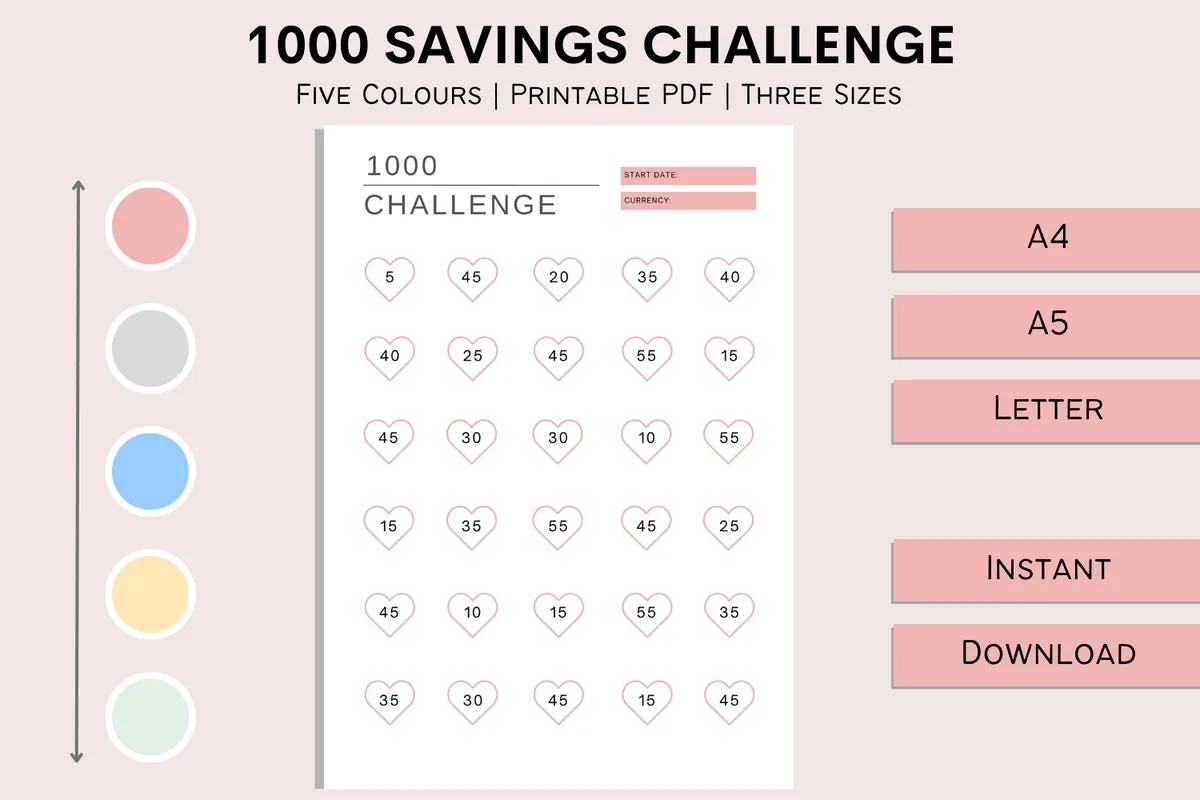 Best for any planner size
- A4, A5, Letter
- 5 colors
What’s insideA printable 1000 savings challenge chart in 5 colors, as PDF files in A4, A5 and US Letter; the cover shows a 1000 Challenge page with start date and amount fields and heart-shaped amounts to color in.
- $1,000 chart
- 5 colors
- A4, A5, Letter
- Start date field
Why I picked it
Three sizes and five colors cover a binder, an A5 planner or the fridge, and the hearts make each deposit feel like a small win.
Keep in mind: it’s one goal only, $1,000; for $2,000 you’d print it twice.
One chart won’t suit every pace, though. Some people want to save $1,000 in a month from a tax refund, some stuff cash envelopes, and some want a $2,000 tracker next to their budget. So I kept looking; my five other finds are further down. For every kind of challenge in one place, see our savings challenge printables roundup.
How the $1,000 Savings Challenge Works
The $1,000 savings challenge is a self-set goal: save one thousand dollars by a date you choose, and track every deposit on a chart. There’s no single official version. You pick the timeline, split $1,000 into weekly, per-paycheck or monthly amounts, and color in a box, circle or envelope each time you move the money.
Why start with $1,000? In the Federal Reserve’s survey of 2025, 63% of adults said they would cover a $400 emergency expense with cash or its equivalent, and 12% said they couldn’t pay it by any means. Only 55% had a rainy-day fund for three months of expenses. A first $1,000 covers the cancelled flight, the car repair or the vet bill without new debt.
$1,000 Savings Challenge Plans
Pick the line that fits your budget, not the fastest one. These are even amounts; round up to the next dollar if that’s easier to remember.
| Timeline | Weekly | Every 2 weeks | Monthly |
|---|---|---|---|
| 30 days | $33.33 a day | ||
| 100 days | $10 a day | ||
| 3 months (13 weeks) | $76.92 | $166.67 (6 paydays) or $142.86 (7) | $333.33 |
| 6 months (26 weeks) | $38.46 | $76.92 | $166.67 |
| 12 months (52 weeks) | $19.23 | $38.46 | $83.33 |
Three ideas for how the $1,000 looks on paper:
- Flat amounts. The same amount every week or payday, one circle each. Easiest to automate.
- Mixed circles. A chart of different amounts ($5, $20, $50) that add up to $1,000. Pick a small one on tight weeks and a big one after payday.
- Envelopes. Number envelopes 1 to 45 and put that many dollars in each one: $1 through $45 adds up to $1,035. Stop at 44 for $990.
A 3-month plan paid every two weeks holds six or seven paydays depending on your start date; our biweekly savings challenge lists the three-paycheck months of 2027.
$2,000 and $5,000 Savings Challenges
Once the first $1,000 is done, the same charts scale up.
| Goal and timeline | Weekly | Every 2 weeks | Monthly |
|---|---|---|---|
| $2,000 in 3 months | $153.85 | $333.33 (6) or $285.71 (7) | $666.67 |
| $2,000 in 6 months | $76.92 | $153.85 | $333.33 |
| $2,000 in 12 months | $38.46 | $76.92 | $166.67 |
| $5,000 in 3 months | $384.62 | $833.33 (6) or $714.29 (7) | $1,666.67 |
| $5,000 in 6 months | $192.31 | $384.62 | $833.33 |
| $5,000 in 12 months | $96.15 | $192.31 | $416.67 |
- $2,000 envelope version. Envelopes $1 through $63 add up to $2,016.
- $2,000 in 100 days. $20 a day, or about $140 a week.
- $5,000 with 100 envelopes. The classic 100 envelope challenge: $1 through $100 adds up to $5,050.
- $5,000 in 100 days. $50 a day, realistic only with a bonus or side income.
- Going bigger. The 10k savings challenge has the math for $10,000.
Smaller goal for now? Our mini savings challenges start under $500, and the low income savings challenges work with a few dollars a week.
Where to Keep the Money
Coloring in a chart is the fun part; where the money sits matters more.
- An insured savings account. The FDIC insures bank deposits up to at least $250,000 per depositor, per ownership category, at each insured bank, and the NCUA covers credit union savings the same way. A separate account named “$1,000 challenge” keeps it out of everyday spending.
- Compare rates. Many high-yield savings accounts pay more than a regular savings account; rates change, so check before you open one.
- Cash envelopes, briefly. Stuffing cash is satisfying, but the FDIC notes that no home safe is completely protected from theft, fire or flood, and cash at home earns no interest. Many people stuff envelopes during the month and deposit the total at the end. Home insurance may cover little cash, so check your policy.
This is general information, not financial advice; for your own situation, talk to your bank or a licensed advisor.
How to Start Your Savings Challenge This Week
Six steps, most of them done in one evening.

- Pick your number and date. $1,000 by June 1, for example.
- Choose the amount from the table that fits your budget. A paycheck budget template shows what’s left after bills.
- Print a tracker and tape it where you’ll see it: closet door, fridge, the first page of your planner.
- Automate the transfer for payday, then color in the circle when it lands.
- Add extras from a no-spend week or a sold item; our no-spend challenge printable helps find them.
- Check in monthly. Behind? Stretch the date instead of quitting.
6 Printable Trackers for Your Challenge
I skipped KDP book interiors in 6 x 9, Canva-only templates, a laser-cut wooden box file, a set whose cover and listing disagree on the timeline, listings that advertise an extra with the word for zero cost on the cover, and trackers already in our other savings posts. I kept one product per designer.
In short: the PixelPearPrints chart for a binder or planner, the Customizables A6 set for cash envelopes, and the jadvin art planner if you want $1,000 and $2,000 trackers with a budget page.

Find your favorite
Quick Picks
Choose a tracker to jump to its review.
- 01Best overall1000 Savings Challenge Money Planner
- 02Best 30-day sprintMoney Saving Challenge,Savings Tracker
- 03Best for cash envelopes1K Money Saving Challenge Budget Planner
- 04Best editable$1000 in 30Days Money Saving Challenge
- 05Best for $1,000 + $2,000Money Saving Planner
- 06Best for kids and teens$1000 Saving Challenge Tracker
How I chose. In order of weight: a $1,000 (or $2,000) goal on the chart; a clear way to color in progress; stated sizes or files that fit a binder, planner or cash envelope; a pace that real budgets can follow; and an easy print. Everything below comes from each product’s page on Creative Fabrica, checked on November 23, 2026. I haven’t printed these myself, so I describe what each designer lists and shows.
02 / Best 30-day sprint
Money Saving Challenge,Savings Tracker
Designed by watercolortheme.
 Best for $1,000 in a month
- PDF + JPEG
- US Letter + A5
- Editable PDF
What’s insideA 1,000 money saving challenge printable for saving 1,000 over 30 days: 2 PDFs and 2 JPEGs in US Letter and A5, one version in two sizes, ink-friendly minimalist design, editable PDF.
- $1,000 in 30 days
- Letter + A5
- Ink-friendly
- Editable PDF
Why I picked it
If you have a bonus or a tax refund to put away fast, the 30 circles are the quickest version of this challenge.
Keep in mind: 30 days is a sprint: the amounts run up to $55 a day, which won’t fit most budgets.
03 / Best for cash envelopes
1K Money Saving Challenge Budget Planner
Designed by Customizables.
 Best for A6 cash binders
- A6
- 8 parts
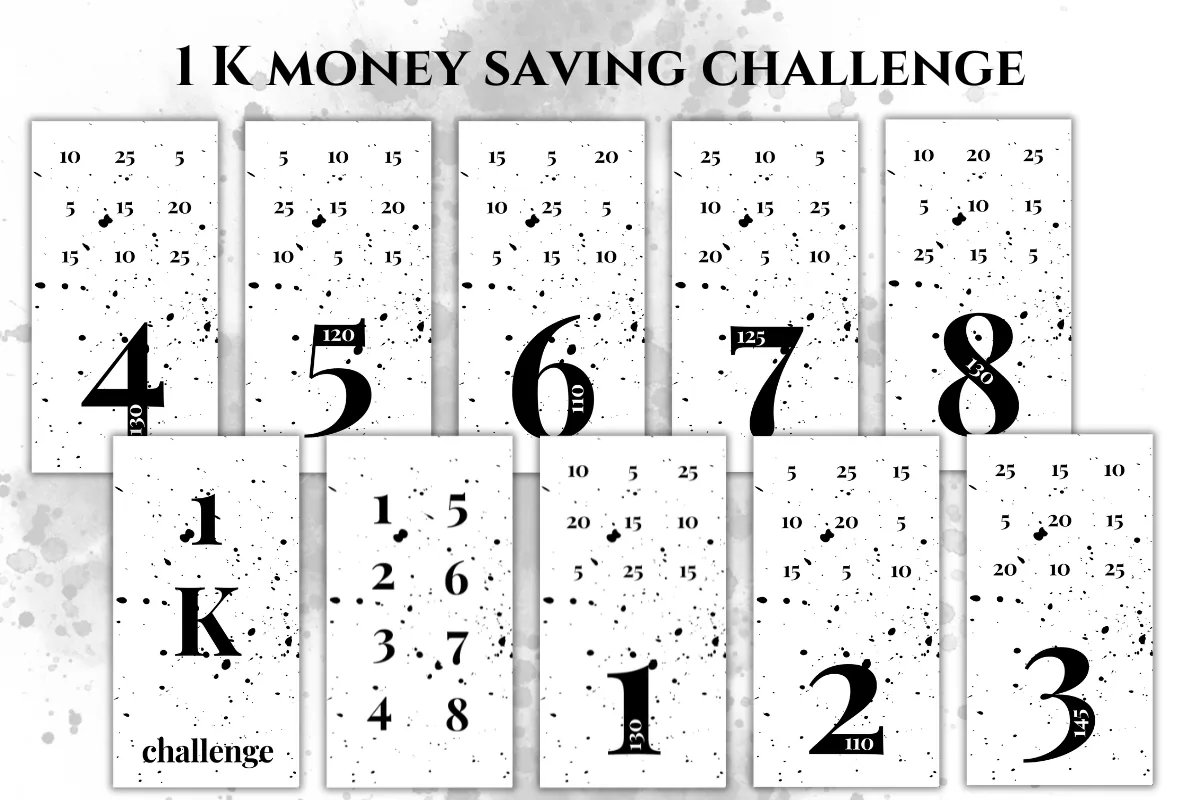
What’s insideMini printables for an A6 cash binder and cash envelopes: save 1000 in 8 parts, a PDF with a tracker and a front page; color in the icon for each savings goal you hit.
- $1,000 in 8 parts
- A6 size
- Cover page
- Cash stuffing
Why I picked it
Splitting $1,000 into eight smaller charts made the goal look doable, and A6 fits right into a cash envelope wallet.
Keep in mind: A6 only, so it’s too small for a wall or a Letter binder.
04 / Best editable
$1000 in 30Days Money Saving Challenge
Designed by srempire.
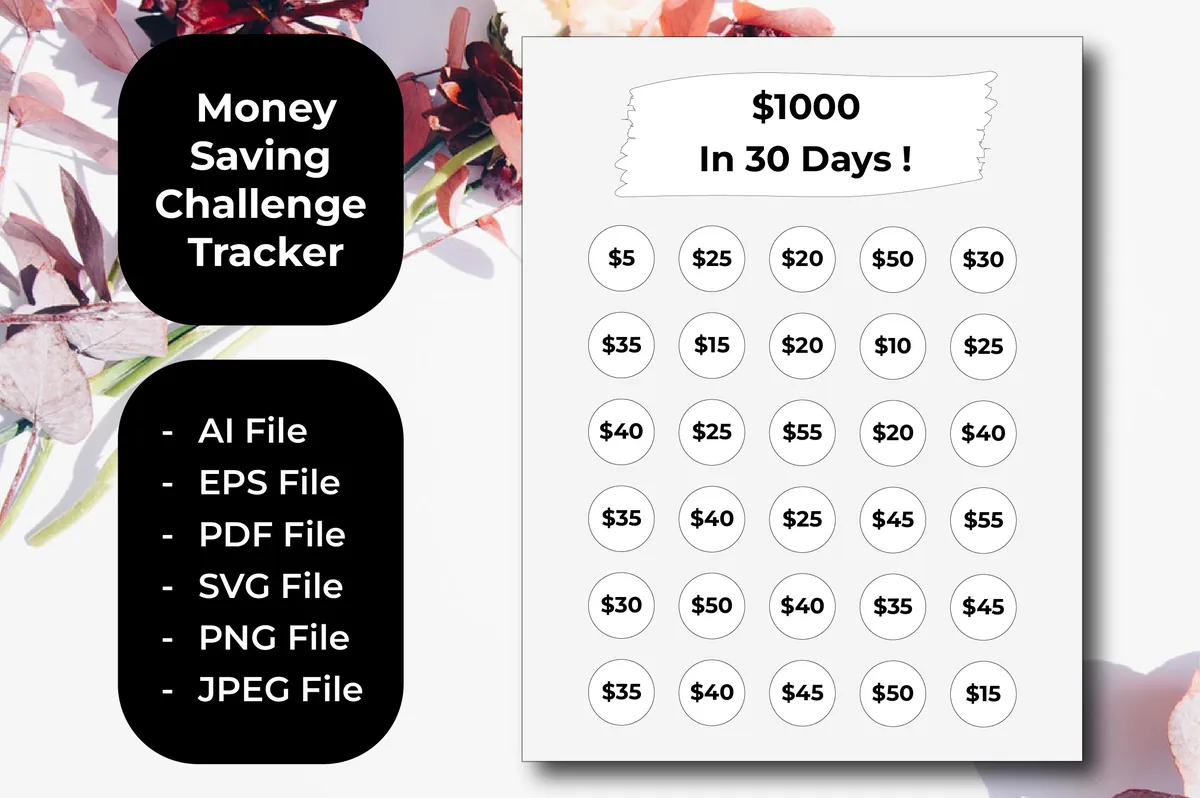 Best for changing the amounts
- PDF + AI + EPS
- US Letter
- PNG + JPG
What’s insideA $1,000 in 30 days money saving challenge tracker: print-ready PDF, editable EPS and AI files, JPG and PNG, 8.5 x 11 inches (Letter, can be resized), 300 DPI.
- $1,000 in 30 days
- Editable AI/EPS
- Letter size
- 300 DPI
Why I picked it
The editable files let you rewrite the circles for a different total or a slower pace, if you have the software.
Keep in mind: editing needs Illustrator or a similar vector program.
05 / Best for $1,000 + $2,000
Money Saving Planner
Designed by jadvin art.
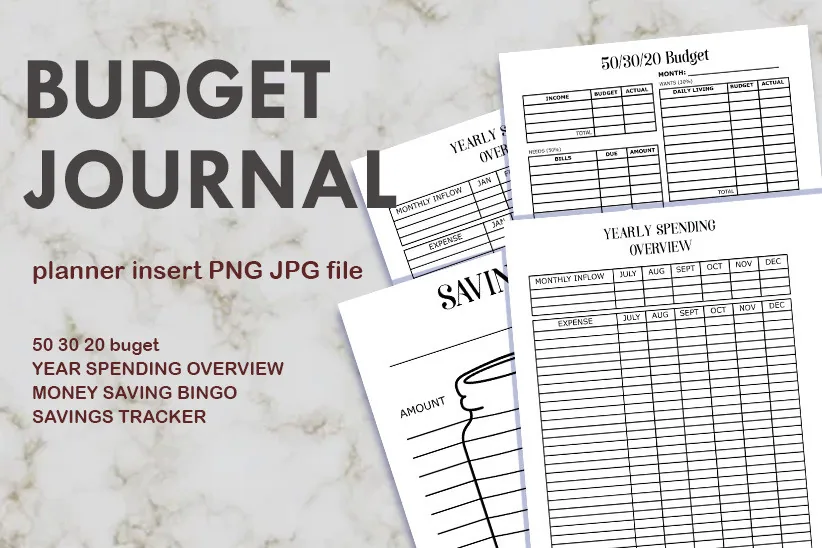 Best for several goals at once
- PNG + JPG
- 9 pages
- Planner inserts
What’s insideA money saving planner with 9 pages as PNG and JPG files: 50 30 20 budget, 2 year spending overview, money saving BINGO, year saving tracker, saving bottle, 1000 fund tracker, 2000 fund tracker and vacation fund tracker.
- $1,000 tracker
- $2,000 tracker
- Saving bingo
- 50/30/20 budget
Why I picked it
It’s the only pick with both a $1,000 and a $2,000 tracker, plus a budget page to find the money for them.
Keep in mind: image files only, no PDF, and the listing doesn’t give the page size.
06 / Best for kids and teens
$1000 Saving Challenge Tracker
Designed by Maatopup.
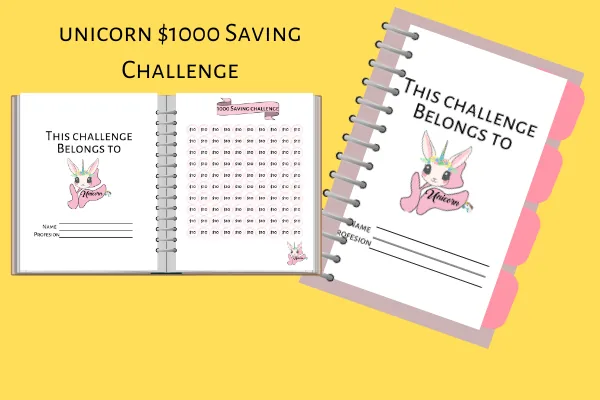 Best for a slower pace
- Printable
- 100 days
- Unicorn theme
What’s insideA $1,000 saving challenge tracker for saving 1,000 in 100 days; the cover shows a unicorn “This challenge belongs to” page and a grid of amounts.
- $1,000 in 100 days
- Belongs-to page
- Amount grid
- Unicorn art
Why I picked it
A hundred days is a gentler pace than thirty, and the unicorn page makes it a fun first challenge for a teen with a job.
Keep in mind: the listing doesn’t name file formats or paper sizes.
Quick Comparison
| Tracker | Goal and pace | Format | Sizes | Best for |
|---|---|---|---|---|
| 1. 1000 Challenge Planner | $1,000 | PDF, 5 colors | A4, A5, Letter | Any planner |
| 2. Savings Tracker | $1,000 in 30 days | PDF, JPEG | Letter, A5 | A fast sprint |
| 3. 1K Budget Planner | $1,000 in 8 parts | A6 | Cash envelopes | |
| 4. $1000 in 30 Days | $1,000 in 30 days | PDF, AI, EPS, PNG | Letter | Editing amounts |
| 5. Money Saving Planner | $1,000 + $2,000 | PNG, JPG | Not stated | Several goals |
| 6. Unicorn Tracker | $1,000 in 100 days | Not stated | Not stated | Teens |
How to Print Your Tracker
Print at actual size (100%) when the file matches your paper; A4 files on US Letter need “fit to page.” The Customizables A6 pages print four to a Letter sheet if your printer offers “multiple pages per sheet,” then cut them apart for a cash binder. Plain printer paper is fine for a chart on the fridge; card stock lasts longer if it lives in a binder. Keep the tracker next to your savings tracker printable pages or your budget planner printables, so the goal and the budget sit together.
A little help
Frequently asked questions
A few answers before you print.
What is the 1000 savings challenge?
A goal to save $1,000 by a set date, tracked on a printable chart. You split the total into weekly, per-paycheck or monthly amounts and color in a box each time you save.
$1,000 per week: 3 months: $76.92 a week 6 months: $38.46 a week 12 months: $19.23 a week
How can I save $1,000 in 3 months?
Save $76.92 a week, $333.33 a month, or $166.67 per paycheck if you’re paid every two weeks and get six paydays in those three months. Automate the transfer on payday.
How do I save $1,000 in 3 months biweekly?
Thirteen weeks hold six or seven biweekly paydays. Save $166.67 per paycheck with six paydays or $142.86 with seven.
How do I save $1,000 in 6 months?
Save $38.46 a week, $76.92 every two weeks or $166.67 a month for 26 weeks.
Can you save $1,000 in 30 days?
Yes, but it’s $33.33 a day, which usually needs a bonus, a tax refund or selling something. The 30-day charts in this post are built for that sprint.
How much is the $5,000 savings challenge in 3 months?
About $384.62 a week or $1,666.67 a month. Over 12 months it drops to $96.15 a week.
Where should I keep my challenge savings?
In a separate insured savings account, ideally one with a good interest rate. The FDIC warns that cash at home isn’t fully protected and earns no interest.
Final Thoughts
The best savings challenge is the one with an amount your budget can keep paying. I’d print the PixelPearPrints chart in A5 for my planner and set an automatic $38.46 transfer every Friday. Pick your number tonight, choose a line from the table, and color in the first circle on payday.