Last December my card statement had three flights on it, two for me and one I’d booked for my sister as a gift, plus every present I bought in the second week of the month. None of it was a surprise. I’d known since spring that I would fly home for Christmas, and I still paid for it all in one month, then spent January quietly paying it back.
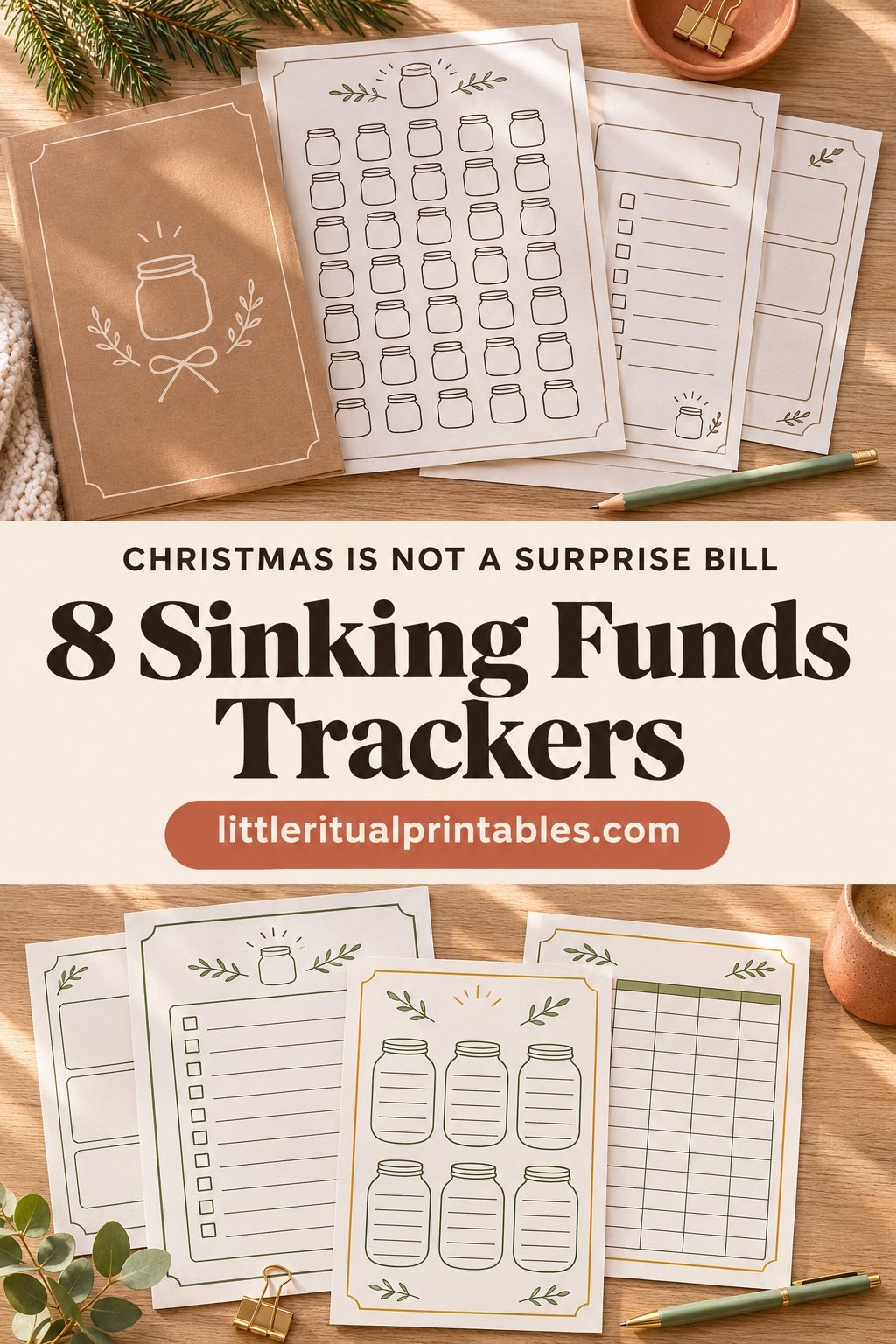
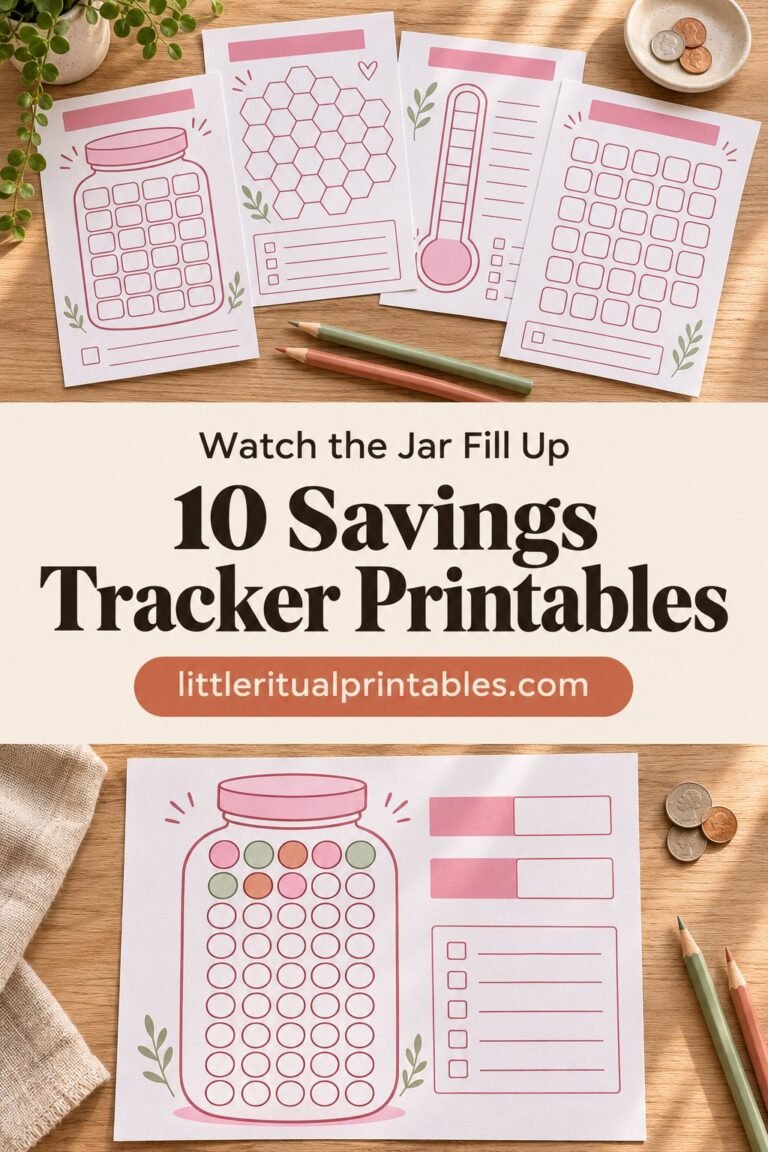
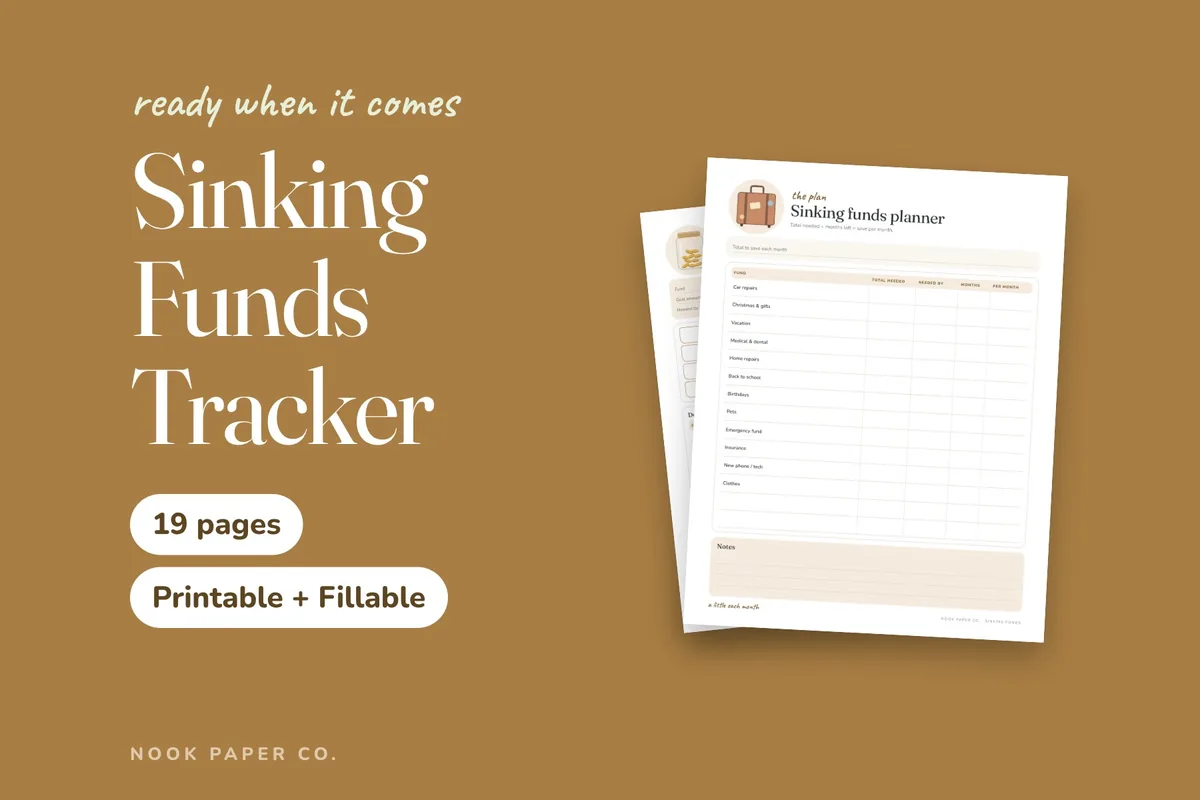
The fix sounded almost too simple when I read about it: a sinking fund, money set aside a little each month for a cost you already know is coming. What I needed was a sinking funds tracker, a page where each of those known costs gets a goal, a date and a monthly amount, and this is the one I found first. It stopped me because the very first planning page asks for the total, the date you need it by, the number of months and the amount per month, and then gives every fund its own page of jars to color in.
01 / Best overall
Sinking Funds Tracker Printable
Designed by Nook Paper Co.
 Best for a first sinking fund
- PDF + fillable
- Letter + A4
- 19 pages
What’s insideA 19-page undated tracker in a warm sandy palette: a page on how sinking funds work with an example and ideas, a planner (total, needed by, months, per month), 12 fund tracker pages with 40 color-in jars plus deposits and withdrawals, a monthly deposits checklist, a fund balances overview and notes.
- 12 fund pages
- 40 color-in jars each
- Per-month math page
- Fillable PDF
Why I picked it
The planner page does the one calculation that matters (total, months, per month) before you track anything, and twelve separate fund pages means Christmas and car repairs never share a line.
Keep in mind: the sandy brown palette uses more ink than a line-only page.
Christmas isn’t the only bill like that, though. My car insurance comes twice a year, the car needs tires at some point, and summer travel shows up every summer without fail. Some people want one page for everything, others want a page per goal, and a few want something to color so they keep going. So I kept looking. Below: what a sinking fund is, which funds to start with, how to set them up in five steps, and my seven other finds.
What a Sinking Fund Is (and Isn’t)
A sinking fund is money you set aside for a planned expense, such as a vacation, holiday gifts or a semiannual insurance premium. Synchrony Bank describes it as savings for large expenses that don’t fit neatly into the monthly budget. An emergency fund is a different pot: Experian defines it as money for unexpected costs like a job loss, a sudden car repair or a vet bill.
The difference matters because the two get mixed up easily. If the Christmas money sits in the emergency account, a broken water heater in November can eat it, and then you’re back to putting gifts on a card.
Two kinds of savings
Sinking fund vs emergency fund
Based on Experian and Synchrony Bank guides.
| Sinking fund | Emergency fund | |
|---|---|---|
| What it’s for | Planned costs | Unexpected costs |
| Examples | Holiday gifts, vacation, insurance premium, tires | Job loss, sudden car repair, vet bill |
| How much | Goal ÷ months left | 3 to 6 months of essential expenses, or a $500 to $1,000 starter |
| When you spend it | On the date you planned | Only when something goes wrong |
Highlighted: where the two differ most.
Keep them in separate places so one doesn’t quietly pay for the other.
A sinking fund also sits next to your regular monthly budget printable, not inside it. The budget pays this month’s bills; the sinking fund line is just one more “bill” you pay to your future self.
Sinking Fund Categories to Start With
Experian lists vacations, technology, weddings, home renovations, semiannual insurance premiums and tax payments as typical sinking funds. Synchrony adds annual insurance premiums, holiday gifts, a new laptop or fridge, property taxes and tires. The best list is the one built from your own last twelve months: look back at your statements and circle every cost that wasn’t monthly.
Christmas earns its place near the top. In the National Retail Federation’s 2025 holiday survey, shoppers planned to spend $890.49 each on the holidays, $627.93 of it on gifts. Spread over twelve months starting in January, $890 is about $74 a month. Started in November, it’s the whole amount at once, which is exactly the bill I paid last year. If you plan the gifts themselves on paper, my Christmas planner printables pair well with a holiday fund.
Start with two or three funds, not ten. Christmas, car costs and one thing you’re looking forward to, like a trip, is a good first set.
How to Set Up Sinking Funds in 5 Steps
The math behind every tracker on this list is the same one Synchrony uses: divide your goal by the number of months until the expense. Their example is $2,400 over 12 months, which comes to $200 a month, or $1,000 for tires due in 10 months, which is $100 a month.

- List the known costs. Go through last year’s bank statements and write down every expense that came once or twice a year.
- Give each one a goal and a date. Use what you actually spent last year as the goal, not what you hoped to spend.
- Work out the monthly amount. Goal minus anything already saved, divided by the months left. Write it next to the fund.
- Pay it on payday. Move the monthly amounts to savings the day your paycheck lands, before anything else gets spent.
- Log deposits and withdrawals. Color a jar or write the new balance each time. When you spend from a fund, write that down too.
If your income changes a lot from month to month, fund the soonest goal first and top up the rest in good months. A fixed monthly amount works best with a steady paycheck.
The 8 Best Sinking Funds Tracker Printables I Found
I skipped KDP book interiors of 120 pages, a listing with a word in its title I don’t use on this site, and trackers that were really generic savings logs. One designer had two good one-page trackers, so I kept both and stopped there. The picks run from a single page to full workbooks.
In short: start with the Nook Paper Co. tracker if you want the planning math and one page per fund, take a watercolortheme page if you want one sheet in three sizes, and go with the Designs Market planner if you want every fund in one binder.

Find your favorite
Quick Picks
Choose a tracker to jump to its review.
- 01Best overallSinking Funds Tracker Printable
- 02Best full systemSinking Funds Planner
- 03Best minimalSinking Funds Tracker
- 04Best for goal boxesSinking Funds Tracker
- 05Best color-inBudgeting Printable Sinking Funds Pdf
- 06Best print + iPadSinking Funds Tracker – Printable & Digi
- 07Best long workbookSinking Fund Planner
- 08Best pastelSinking Funds Tracker Budget Planner
How I chose. In order of weight: real sinking fund columns such as a goal, a date or months left, a monthly amount and a running balance; a printable file with its size stated; one clear job, from a one-page overview to a full workbook; and a design calm enough for a budget binder. Everything below comes from each product’s page on Creative Fabrica, checked on November 11, 2026. I haven’t printed these myself, so I describe what each designer lists and shows.
02 / Best full system
Sinking Funds Planner
Designed by Designs Market.
 Best for many funds at once
- Printable
- 35 pages
What’s insideA 35-page sinking funds workbook with a master fund list, annual and monthly funding plans, a contribution schedule, a balance tracker, a dashboard, short- and long-term fund trackers and ready pages for home, vehicle, medical, travel, gifts, holidays, education, technology and emergency funds.
- Master fund list
- Contribution schedule
- Withdrawal tracker
- Annual review
Why I picked it
If you want every irregular expense planned in one binder, this has a page for each step, from the master list to the year-end review.
Keep in mind: the listing doesn’t state the paper size.
03 / Best minimal
Sinking Funds Tracker
Designed by watercolortheme.
 Best for ink-friendly printing
- Editable PDF + JPEG
- Letter, A4, A5
- 1 page
What’s insideOne minimalist sinking funds tracker page in three sizes (US Letter, A4 and A5) as editable PDF and JPEG files, with columns for categories, starting balance, amount and new balance.
- Three paper sizes
- Editable PDF
- Ink-friendly design
- Running balance columns
Why I picked it
Every fund gets one line with a starting balance and a new balance, which is all most households need to see the totals in one glance.
Keep in mind: it’s a single page design, so there’s no planning page to work out monthly amounts.
04 / Best for goal boxes
Sinking Funds Tracker
Designed by watercolortheme.
 Best for six goals per page
- Editable PDF + JPEG
- Letter, A4, A5
- 1 page
What’s insideA minimalist sinking funds tracker as editable PDF and JPEG files in US Letter, A4 and A5, with separate goal amount boxes so several funds fit on one page; the designer mentions saving for a propane bill, Christmas gifts and car repairs.
- Goal amount boxes
- Three paper sizes
- Editable PDF
- Ink-friendly design
Why I picked it
Each fund gets its own small table with a goal amount at the top, so you can watch several goals fill up on one sheet.
Keep in mind: the boxes are small, so it fits about six funds per page and long names get cramped.
05 / Best color-in
Budgeting Printable Sinking Funds Pdf
Designed by Screech Owl Supply.
 Best for visual savers
- Printable
- 1 page
What’s insideA printable sinking funds tracker PDF for planning ahead for expected and unexpected costs; the cover shows boxes for holiday gifts, birthday gifts, home repairs, car repairs, vacation and back to school, each with a goal, a monthly contribution and circles to color in.
- Six preset categories
- Goal and monthly lines
- Circles to color
- Botanical line art
Why I picked it
Coloring a circle every time you set money aside is the same small reward that keeps savings challenges going, applied to real bills.
Keep in mind: the categories are preset on the cover page and the listing is short on detail.
06 / Best print + iPad
Sinking Funds Tracker – Printable & Digi
Designed by Plamarplanners.
 Best for paper and tablet
- A4 + Letter
- Print or iPad
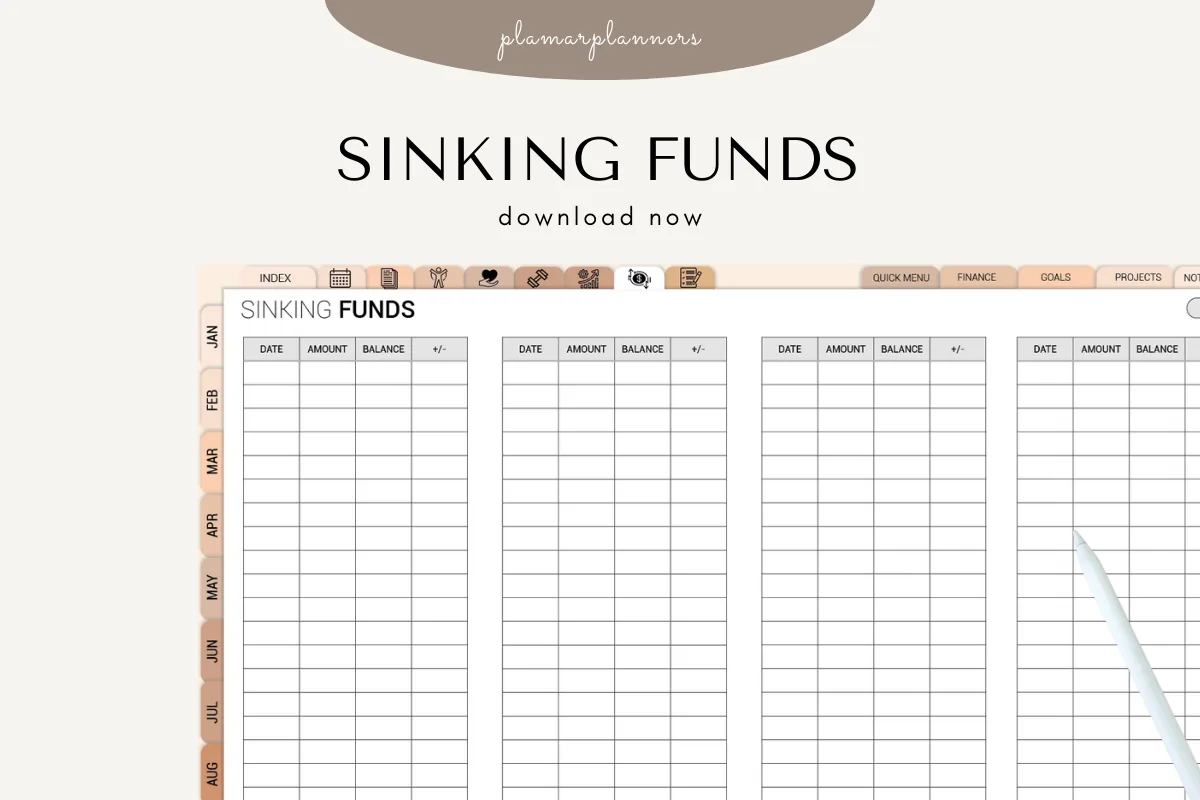
What’s insideA sinking funds tracker as a PDF in A4 and US Letter plus a digital version for iPad apps such as GoodNotes and Notability, with a sinking fund overview, individual fund trackers, a contribution log, a goal progress chart and a notes section.
- Contribution log
- Goal progress chart
- Overview page
- Digital version too
Why I picked it
It tracks contributions, remaining balance and goal amount, and you can keep the same layout on paper and on a tablet.
Keep in mind: the tabbed digital layout is the star of the cover, so the print pages look plainer.
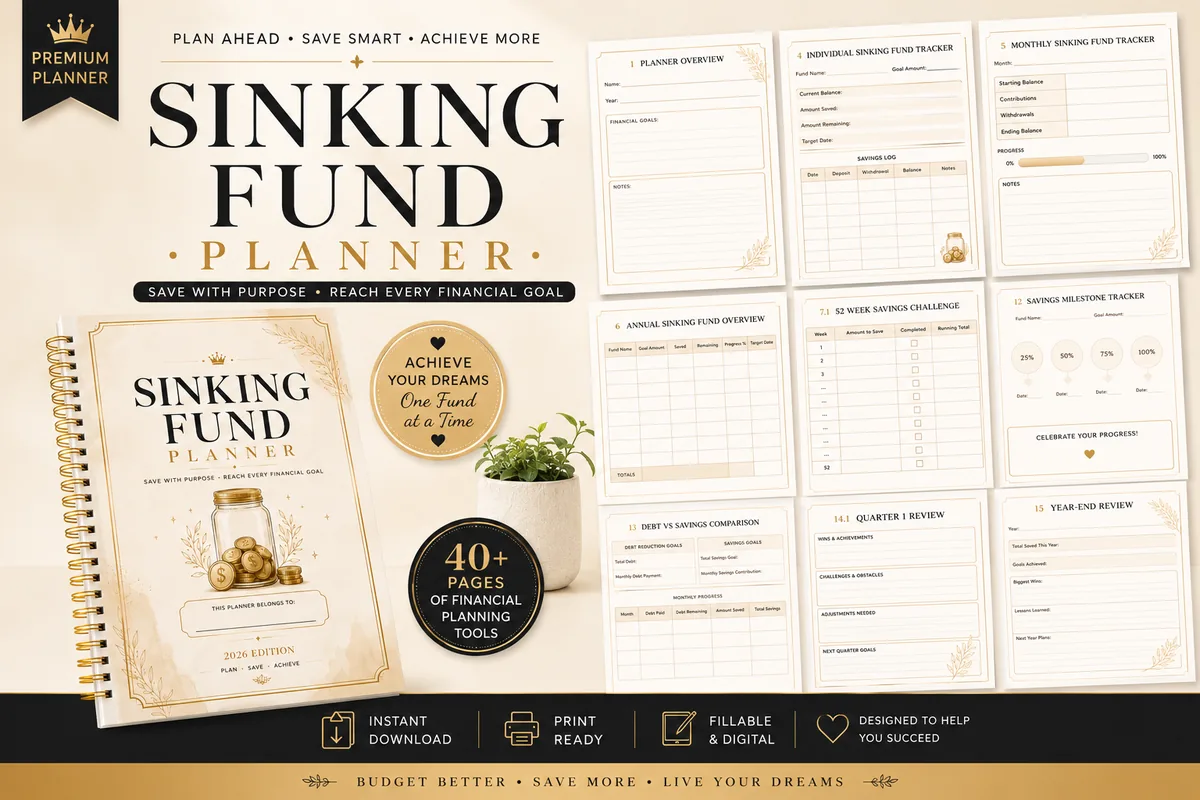
07 / Best long workbook
Sinking Fund Planner
Designed by Azhir.
 Best for a whole money year
- A4
- Undated
What’s insideA long undated A4 sinking fund planner PDF for savings goals, sinking fund tracking, future expenses and savings challenges; the description says 79 pages and the cover badge says 40+ pages of financial planning tools.
- Undated
- A4 size
- Savings challenges
- Future expenses plan
Why I picked it
If you want sinking funds inside a bigger savings workbook, this one adds goals and challenges around the fund trackers.
Keep in mind: the listing gives two different page counts (79 in the text, 40+ on the cover), and it’s A4 only.
08 / Best pastel
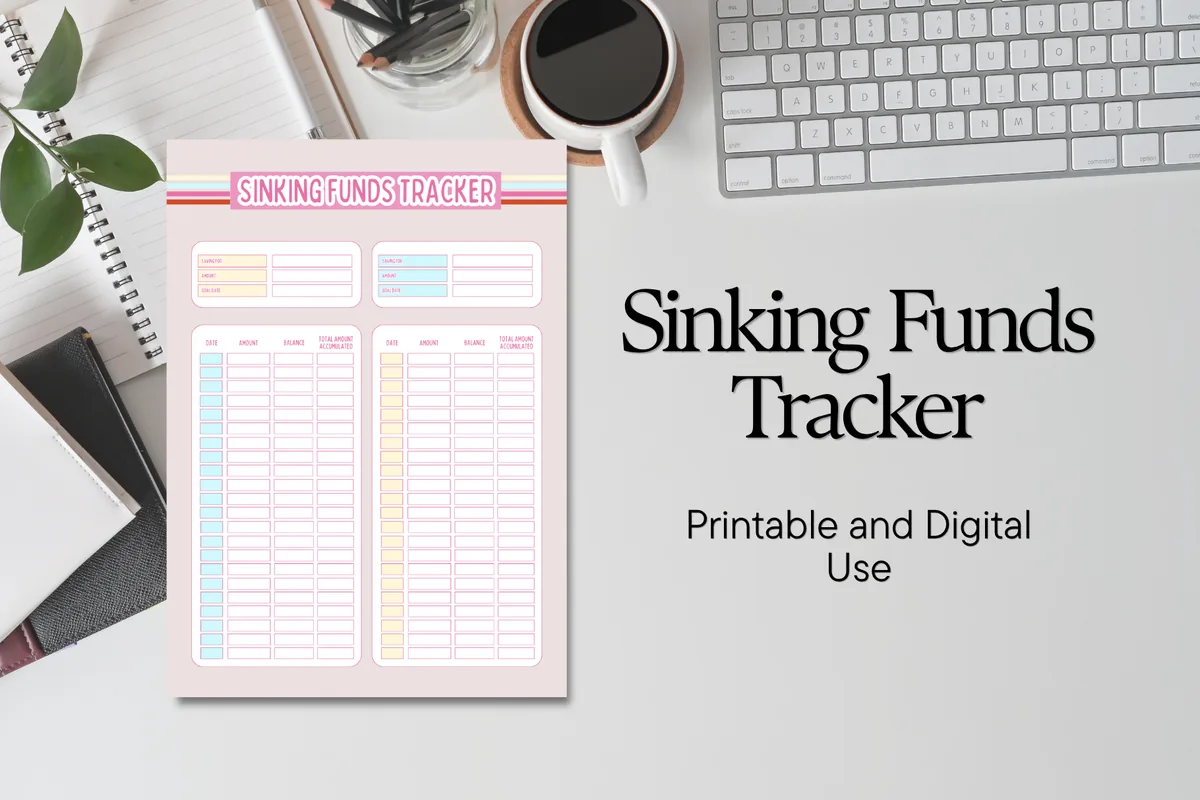
Sinking Funds Tracker Budget Planner
Designed by Anny Sketches.
 Best for a bright budget binder
- Printable
- Print or tablet
What’s insideA sinking funds tracker printable PDF for savings categories such as vacations, holidays, bills and long-term goals, shown on the cover as a pink and pastel two-column page.
- Pastel color blocks
- Vacations and holidays
- Bills and long-term goals
- Print or tablet
Why I picked it
The two-column pastel layout is easy to read from across the kitchen, which matters if the page lives on the fridge.
Keep in mind: the listing is short: one PDF, no size or page count stated.
Quick Comparison
| Product | Style | What’s inside | Sizes/format | Standout |
|---|---|---|---|---|
| 1. Nook Paper Co. | Sandy brown | 19 pages | Letter + A4 / fillable PDF | Per-month planner |
| 2. Full Planner | Green and gold | 35 pages | Contribution schedule | |
| 3. Minimal Page | Black and white | 1 page | Letter, A4, A5 / PDF | Running balance |
| 4. Goal Boxes | Black and white | 1 page | Letter, A4, A5 / PDF | Goal per box |
| 5. Color-In | Botanical line art | 1 page | Circles to color | |
| 6. Print + iPad | Beige | Overview + logs | A4 + Letter / PDF | Progress chart |
| 7. Long Workbook | Cream and gold | Workbook | A4 / PDF | Savings challenges |
| 8. Pastel Page | Pink pastel | Tracker page | Easy to read |
One Page, Full Workbook or Color-In: Which Sinking Funds Tracker Fits You
One page for everything
Picks 3, 4 and 8 put all your funds on one sheet. They suit two to six funds and anyone who wants the totals in one glance. If you have more than six funds, the lines get crowded fast.
A full workbook
Picks 1, 2, 6 and 7 give each fund room and add planning pages for the math. They fit a budget binder and a household with many irregular bills. If you only save for Christmas, they’re more paper than you need.
Color as you save
Pick 5, and the jar pages inside pick 1, turn every deposit into a jar or circle to color. They help if you’ve quit budgets before because nothing felt like progress. Skip them if coloring feels like a chore; a balance column is faster.
What I Look For in a Sinking Funds Tracker
- A goal and a date: without a due date, there’s no monthly amount.
- A monthly amount column: the number you actually move on payday.
- Already saved and left to save: so you can recalculate when a goal changes.
- A withdrawals line: money out of a fund is easy to forget.
- Undated pages: start in any month and reuse next year.
- Red flags in a listing: “KDP interior” with 100+ pages, “ready for upload to Amazon,” or “digital only” when you want paper.
Sinking funds don’t replace the other money pages. If you’re paying off a card, track that on a debt payoff tracker printable, and if you want to find where the monthly amount will come from, a month on an expense tracker printable usually shows it. For a starting habit rather than a goal, the 52 week savings challenge and the 100 envelope challenge build the saving muscle, and the savings challenges for a low income start with $5. My full roundup of budget planner printables has the monthly pages these trackers sit beside.
How to Print and Use a Sinking Funds Tracker
Print at actual size or 100% so the rows keep their height. In the US, use the US Letter file; picks 1, 3, 4 and 6 also come in A4, and the two watercolortheme pages include A5 for a smaller ring planner. Pick 7 is A4 only, so choose “fit to page” on Letter paper.
Heavier paper helps for a page you’ll write on all year. Put the overview page at the front of your budget binder, behind a clear sheet protector if you like to see it every time you open it, and keep the single-fund pages behind it. If you’d rather type, pick 1 is a fillable PDF and the watercolortheme pages are editable PDFs. A plain binder cover printable on the front makes it easy to grab on payday.
Sinking funds are one page of many; see our budget planner page ideas for the others.
A little help
Before you set the Christmas fund goal, ask everyone for a Christmas wish list with a price range, so the number you save toward is real.
When the holiday fund is ready to spend, a Christmas gift list template with a price for each person keeps the spending inside the fund.
Once-a-year bills such as car insurance belong on your bill tracker printable too, so you can see when each sinking fund will be spent.
For a single big goal, such as a trip or an emergency fund, a printable savings tracker turns the target into boxes to color in.
Frequently asked questions
A few answers before you print.
What is a sinking funds tracker?
It’s a page that lists the costs you’re saving for ahead of time, each with a goal, a due date, a monthly amount and a running balance. You update it every time you put money aside or spend from a fund, so you can see whether each goal is on pace before the bill arrives.
Sinking fund basics: Goal ÷ months = monthly amount One fund per known cost Separate from emergencies
How do you track sinking funds?
Write each fund’s goal and due date, divide the goal by the months left, and move that amount to savings on payday. Then log every deposit and withdrawal on the tracker, by writing the new balance or coloring a jar. Once a month, check whether each fund is where it should be.
What is the difference between a sinking fund and an emergency fund?
A sinking fund is for planned costs you know are coming, like holiday gifts, a vacation or an insurance premium. An emergency fund covers the unexpected, such as a job loss or a sudden car repair. Experian puts an emergency fund goal at 3 to 6 months of essential expenses.
Are sinking funds the same as savings?
They’re a kind of savings with a job attached. General savings has no deadline, while each sinking fund has a goal and a date. Many people keep sinking funds in one savings account and use the printable tracker to see how much of the balance belongs to each goal.
What are common sinking fund categories?
Holiday gifts, vacations, car maintenance and tires, insurance premiums, property taxes, home repairs, technology and back to school costs are common. The most useful list comes from your own bank statements: every cost from the past year that didn’t come monthly is a candidate.
How much should I put in each sinking fund?
Divide the goal by the number of months until you need it. Synchrony’s example: $2,400 over 12 months is $200 a month, and $1,000 for tires due in 10 months is $100 a month. If you’ve already saved part of it, subtract that first.
If one of your funds is a big one, a 10K savings challenge chart shows the whole goal on one page.
Final Thoughts
A sinking funds tracker turns a bill you know about into a small amount you pay every month, and Christmas is the easiest place to start. I’d pair the Nook Paper Co. tracker for planning with the color-in page from Screech Owl Supply on the fridge as a reminder. Tonight, open last year’s December statement and write down the total. That’s your first goal.